Think about how many things people pay for online these days. Mobile recharge, DTH, electricity bill, gas bill, broadband bill – the list goes on. Most people don’t want to open five different apps to do this. They want one app that does everything.
That’s exactly what a multi-recharge app does. And if you’re thinking of building one, you’re looking at a business idea that has steady demand, repeat customers, and more than one way to earn money. This guide breaks down what goes into multi-recharge app development, so it’s easy to follow! Whether you’re a business owner, a startup founder, or just exploring the idea.
At Fusion Codes, we build these kinds of apps for clients who want something that actually works well, not just something that looks nice on the surface. Let’s get into it.
What Exactly Is a Multi-Recharge App?
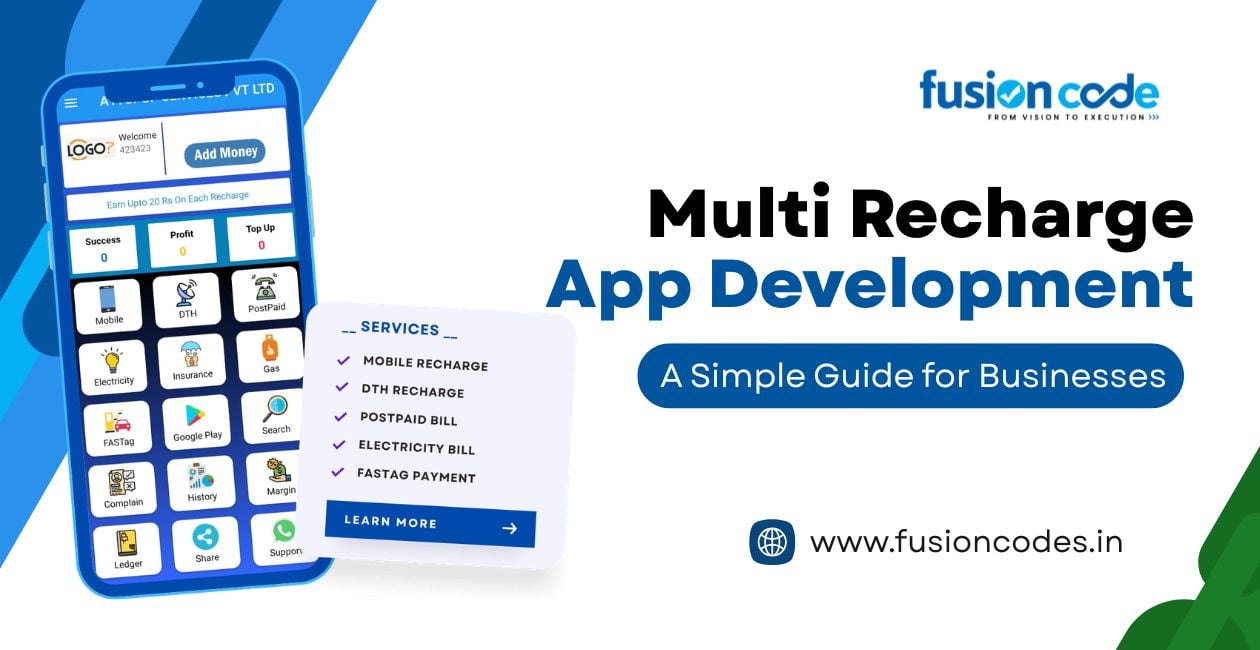
In simple terms, it’s an app where a user can:
- Recharge a prepaid mobile number
- Renew a DTH connection
- Pay electricity, water, gas, or broadband bills
- Top up a wallet and use it for any of the above
One app, many services. That’s the whole idea.
For the business owner running the multi-recharge app development, it’s not just about helping users! It’s also about earning. Every recharge or bill payment usually carries a small commission. Multiply that across thousands of daily transactions, and you can see why so many companies want a piece of this market.
Why Build a Recharge App in the First Place?
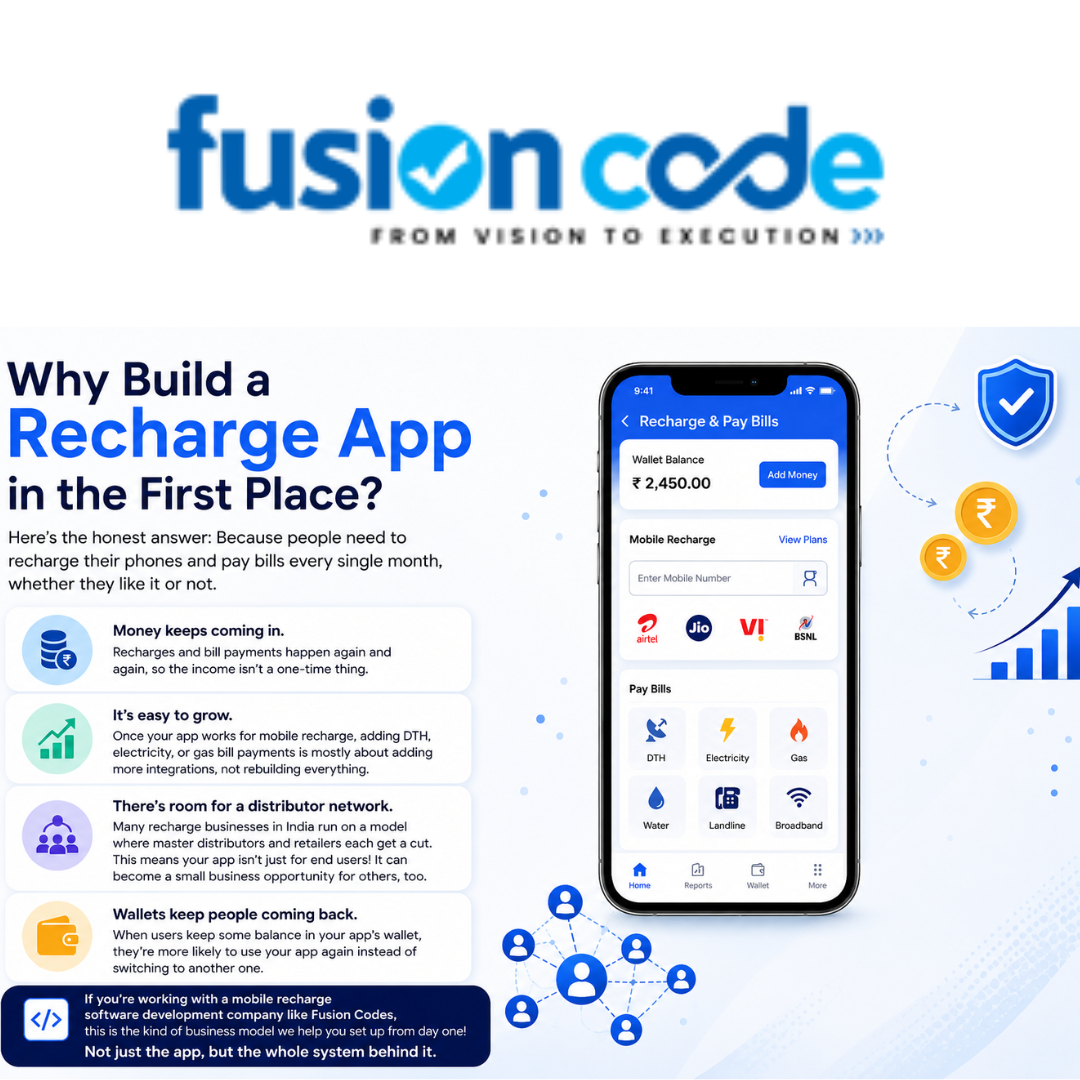
Here’s the honest answer: Because people need to recharge their phones and pay bills every single month, whether they like it or not. That means:
- Money keeps coming in. Recharges and bill payments happen again and again, so the income isn’t a one-time thing.
- It’s easy to grow. Once your app works for mobile recharge, adding DTH, electricity, or gas bill payments is mostly about adding more integrations, not rebuilding everything.
- There’s room for a distributor network. Many recharge businesses in India run on a model where master distributors and retailers each get a cut. This means your app isn’t just for end users! It can become a small business opportunity for others, too.
- Wallets keep people coming back. When users keep some balance in your app’s wallet, they’re more likely to use your app again instead of switching to another one.
If you’re working with a mobile recharge software development company like Fusion Codes, this is the kind of business model we help you set up from day one! Not just the app, but the whole system behind it.
What Should Your Multi-Recharge App Development Actually Have? (Key Features)
There’s a difference between an app that “can do recharges” and one that does it well. Here’s what really matters.
1. Prepaid Mobile Recharge
This is the heart of any prepaid recharge app development project. A user types in a mobile number, and the app figures out the operator and circle automatically, shows available plans, and confirms the recharge within seconds. Sounds simple, but getting this fast and accurate is where most of the engineering effort goes.
2. Bill Payments for Utilities
This is where utility bill recharge app development comes in. Electricity, water, gas, broadband, landline, and even insurance premiums: users should be able to pay all of these from the same app. To make this possible, the app needs to connect with biller networks and BBPS (Bharat Bill Payment System) partners, since most utility providers in India work through this system.
3. A Built-In Wallet
Wallet integration in recharge app platforms isn’t just a nice extra! It actually changes how people use the app. Instead of entering card details every single time, users add money once and spend it across recharges and bills. For your business, this also means fewer payment gateway charges per transaction and better cash flow if you’re running a distributor model.
4. Transactions That Happen Instantly
Nobody likes waiting after they’ve already paid. Real-time recharge transaction processing means the second a payment goes through, the request is sent to the operator or biller right away. If this part is slow or unreliable, users will simply stop using your app: It’s that simple.
5. A System to Handle Commissions
If your app works with retailers, agents, or distributors, you’ll need a recharge commission management system. This part of the app automatically works out how much commission each person earns, based on the operator, the service, and the slab rates you’ve set. No manual calculations, no confusion: Everyone sees what they’ve earned and when.
6. Handling Failed Recharges Properly
Sometimes a recharge fails even after the money is deducted; maybe the operator’s server was down, or there was a network glitch. A good automated recharge failure & retry system catches this automatically, tries again through a backup route, and, if it still doesn’t work, refunds the user right away. This one feature alone can save a business from a lot of unhappy customers.
7. Safe and Reliable Payments
Since real money moves through this app every day, the payment side needs to be solid. That means supporting UPI, debit/credit cards, net banking, and wallet payments, all through gateways that meet PCI-DSS security standards.
8. An Admin Panel That Actually Helps
The person running the business needs to see what’s happening: transactions, commission payouts, operator margins, and customer complaints, all in one dashboard. Without this, managing a recharge business becomes guesswork.
Read Also: Keyword Research: From Google SEO to AI Search, The Complete Guide
Where Does NPCI Fit Into All This?
If you’re building anything related to digital payments in India, you’ll eventually come across NPCI (National Payments Corporation of India). NPCI runs UPI and also operates BBPS, the bill payment network that most recharge apps rely on for utility payments.
If your app wants to accept UPI payments or connect to electricity, gas, and water billers across India, it’s working within the framework NPCI has set up. Skipping this isn’t really an option if you want your app to work the way users expect.
What Can You Learn From the Big Players?
It helps to look at how the major apps approached this space:
- Paytm started with mobile recharges years ago and slowly grew into a full digital payments app, adding bills, wallets, and a lot more along the way.
- PhonePe leaned heavily into UPI from early on, making payments and recharges feel almost instant, and that speed is a big part of why people stuck with it.
- Google Pay simply added recharge and bill payment options into an app people were already using for sending money to friends and family, which made adoption easy.
On the telecom side, Airtel and Jio keep changing their prepaid plans and offers fairly often. This means your app’s backend needs to stay in sync with these changes constantly! Otherwise, users will see outdated plans, which leads to complaints and failed multi-recharge app development recharges.
If you want to read more about how payment rules are evolving in India, the Reserve Bank of India’s bulletin page is a decent place to start.
What Goes on Behind the Scenes (Tech Stack)
You don’t need to become a developer to understand this, but it helps to know what’s usually used:
- Backend: Node.js, Java (Spring Boot), or PHP (Laravel): this is where all the logic and API connections live
- App side: Native Android (Kotlin) and iOS (Swift), or Flutter/React Native if you want one codebase for both
- Database: MySQL or PostgreSQL for storing transactions, with Redis used to speed up things like loading recharge plans
- APIs: Recharge aggregator APIs, BBPS biller APIs, and UPI payment gateways
None of this needs to be perfect on day one, but it does need to be built multi-recharge app development in a way that can handle a sudden spike in traffic, like everyone trying to recharge on the 1st of the month.
Why Work With Fusion Codes?
We’ve built multi-recharge app development platforms before, so we know where things usually go wrong: slow operator APIs, messy commission structures, and wallets that don’t reconcile properly. Our job is to make sure you don’t run into these problems after launch.
When you work with us as your mobile recharge software development company, here’s what you get:
- An app built around your specific business model, not a generic template
- Wallet integration that works smoothly with multiple payment options
- A commission system that’s transparent for every retailer and distributor
- Fast, reliable transaction processing with proper failure handling built in
- Support after launch, including keeping operator plans and offers updated
Whether you’re starting fresh or adding recharge services to something you already run, we can help you get there.
Frequently Asked Questions: multi-recharge app development
1. How long does it take to build a multi-recharge app?
It depends on how many features you want. A basic version with just prepaid mobile recharge can be ready in a few weeks. A full platform with wallet, bill payments, and commission management usually takes a few months.
2. Do I need any special licence to run a recharge business in India?
The app itself doesn’t need a license. But if you’re handling user wallets and storing their money, you may need to follow RBI rules around prepaid payment instruments or work with a licensed partner for the wallet part.
3. Can the app support both Airtel and Jio recharges in one place?
Yes. That’s actually the whole point of multi-recharge app development! Users can recharge any operator’s number from the same app, without needing separate apps for each network.
4. What is BBPS, and why does my app need it?
BBPS stands for Bharat Bill Payment System. It’s a network set up under NPCI that connects apps to electricity, water, gas, and other billers across the country. Without BBPS, offering utility bill payments becomes much harder.
5. How does the commission system work for retailers?
Every time a retailer or distributor processes a recharge or bill payment, the system calculates their commission automatically based on rates you’ve set for each operator or service. They can see their earnings without anyone doing manual math.
6. What if a recharge fails after the user has already paid?
This is handled automatically. The system tries again through a backup connection, and if it still fails, the money goes back to the user’s wallet or account: No manual follow-up needed.
7. Can I add UPI as a payment option?
Definitely. UPI is one of the most-used payment methods in India, thanks to apps like PhonePe, Google Pay, and Paytm. Fusion Codes makes sure UPI for multi-recharge app development is built in as a smooth payment option from the start.
8. Will the app work on both Android and iPhone?
Yes. We can build a multi-recharge app development natively for Android and iOS separately or use Flutter/React Native to build one app that works on both. It depends on what fits your budget and plans better.
Final Thoughts: multi-recharge app development
The multi-recharge app development and bill payment space isn’t slowing down; if anything, more people are moving away from cash every year. Building your own multi-recharge app means tapping into a business that earns through repeat transactions, has room for a distributor network, and can grow into new services over time without starting from scratch.
If this sounds like something you want to explore, reach out to Fusion Codes. We’ll walk you through what’s possible based on your budget, timeline, and the markets you want to target.