A few years ago, opening a savings account meant a trip to the branch, a stack of forms, and a token number you’d wait an hour to hear called out. Today, you can open one on your phone before your coffee gets cold. That shift didn’t happen by accident. Somewhere behind every instant loan approval, every “your payment was successful” notification, and every chatbot that actually answers your question correctly, there’s a team of engineers who understood both code and compliance well enough to make finance feel effortless.
That’s the whole game for a fintech software development company, and the market backs up just how big this game has got. Fortune Business Insights puts the global fintech market at roughly $460 billion in 2026, and it’s not slowing down anytime soon. Banks, NBFCs, insurers, and scrappy fintech startups are all racing each other to digitise, and the ones winning that race aren’t necessarily the ones with the biggest budgets. They’re the ones whose software actually works under real-world pressure.
We’re Fusion Codes, and we build that software. Banks, NBFCs, insurers, and fintech founders come to us when they need financial technology solutions that hold up, not just demos that look good in a pitch deck.
What Is Fintech Software Development?
Strip away the buzzwords, and fintech software development is simply this: building software that handles money safely, accurately, and fast. Payments, lending, banking, insurance, wealth management – it’s all under this umbrella.
Here’s what makes it different from building, say, a food delivery app. Every transaction has to reconcile to the rupee. Every action needs an audit trail that a regulator could pull up years later. Sensitive financial data has to be encrypted in ways that would make a normal app developer’s head spin. None of this is optional, and none of it can be patched in after launch without a lot of pain. That’s why fintech software development services get treated as their own specialised field rather than just another flavour of app development.
What Does a Fintech Software Development Company Do, Exactly?
People often picture this as “writing code that moves money around”, but that’s only a slice of it. A fintech software development company is really translating financial products and regulatory rulebooks into something a phone screen can display and a server can run reliably at 2 a.m. on a Saturday.
In practice, that means:
- Turning loans, insurance policies, savings products, and investment plans into actual digital workflows that people can complete in minutes
- Building APIs that talk to core banking systems, payment processors, and outside data sources without breaking
- Baking in compliance logic for regulators like the RBI, SEBI, or IRDAI, instead of bolting it on later
- Designing systems that won’t fall over when transaction volume spikes (think: payday, festival sales, exam result day for an EMI app)
- Wiring fraud detection, KYC checks, and risk scoring into the user journey so they’re invisible to good users and obvious to bad actors
- Keeping the platform running, secure, and current long after launch day, because regulations and threats both keep moving
We treat every one of these as its own discipline at Fusion Codes. A fintech software development company app that looks polished in a demo but cracks under a regulatory audit or a traffic spike isn’t really finished. It just hasn’t met reality yet.
Fusion Codes: A Fintech Development Company Rooted in Lucknow, Built for the World
We’re proud to call ourselves a fintech development company in Lucknow. It gives us a cost-efficient base to operate from while we work with banks, NBFCs, insurers, and fintech founders across India and beyond. Lucknow’s tech scene has grown fast, and that means we get strong engineering talent without the price tag of a metro-only operation, so early-stage founders can build something genuinely enterprise-grade without burning their entire seed round on a fintech software development company .
Being a fintech solution provider isn’t a label we slap on after the fact, either. Before any engineer on our team touches production code for a fintech client, they spend time understanding the financial logic underneath it: how ledgers balance, how settlement cycles work, how interest actually compounds. That groundwork matters more than people expect, because the bugs that hurt the most in fintech software development company aren’t the ones users notice. They’re the ones an auditor finds six months later.
Read Also: Keyword Research: From Google SEO to AI Search, The Complete Guide
Our Fintech App Development Company Services
Here’s the breakdown of what we actually build, organised around the categories shaping modern financial technology today.
Custom fintech software development. Not a template stretched to fit your business. We build around your specific model, whether that’s a digital lending NBFC, a B2B payments rail, or a wealthtech platform with its own quirks.
Neobanking platforms. Full digital-banking experiences: account opening, virtual cards, transaction management, and spend analytics, all built in partnership with licensed banking entities.
Embedded finance integration. If you run an e-commerce platform, a SaaS product, or a marketplace and want to offer payments, lending, or insurance without sending users somewhere else, this is where we plug it in directly.
Loan management systems. Origination, underwriting, disbursal, EMI scheduling, collections, NPA tracking, the works – built to align with RBI’s digital lending framework rather than fight against it.
Personal finance apps. Budgeting, goal-based saving, expense categorisation, and investment tracking. Tools designed around how people actually spend and save, not just another dashboard nobody opens twice.
Expense management software. Corporate spend tracking, automated approvals, card reconciliation, and policy enforcement for teams that are tired of chasing receipts.
InsurTech software. Policy issuance, claims automation, underwriting engines, and self-service portals that pull insurance out of filing cabinets and into something customers can actually use.
API integration. Connecting core banking systems, payment gateways, credit bureaus, KYC providers, and account aggregator frameworks so everything talks to everything else without duct tape holding it together.
AI in Fintech: Powering Smarter Financial Services Automation
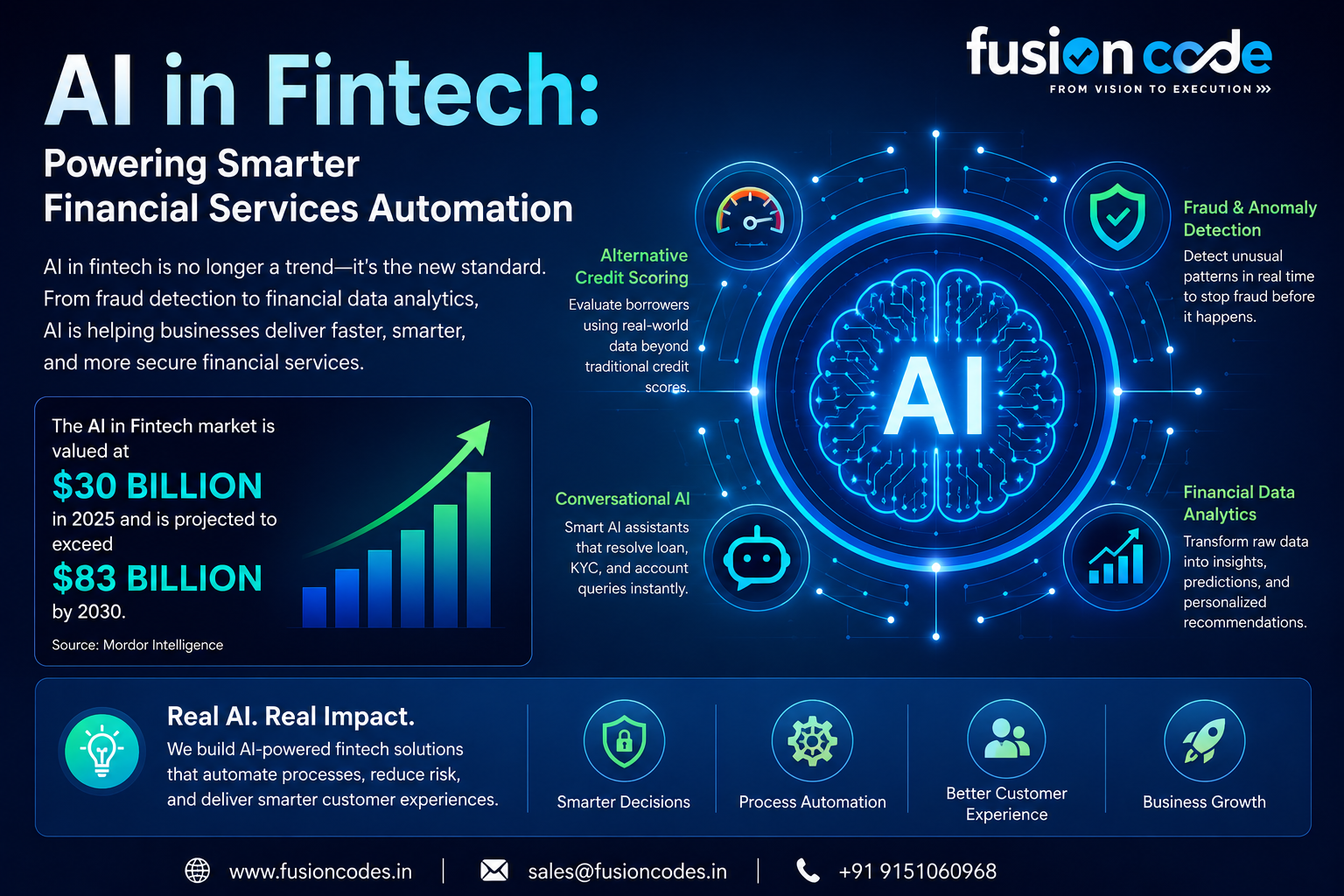
AI in fintech stopped being a novelty a while back. Mordor Intelligence values the AI-in-fintech segment at around $30 billion in 2025, with projections pushing past $83 billion by 2030, as fraud detection, credit scoring, and customer service automation go from “nice to have” to “expected”.
What does that look like when it’s actually useful, rather than AI for AI’s sake? At Fusion Codes, it tends to show up as the best fintech software development company:
- Alternative credit scoring that uses transaction history, utility payments, or GST filings to evaluate borrowers who don’t have a traditional credit file
- Fraud and anomaly detection that catches a weird transaction pattern in real time, instead of three days later in a report nobody reads
- Conversational AI that can actually resolve a loan query or KYC question, not just deflect it
- Financial data analytics that turns raw transaction logs into spending insights, churn signals, and product recommendations that feel relevant instead of random
This is the difference between a fintech product that feels modern and one that’s just a digitised version of the same old paper process, dressed up with a nicer UI.
Fintech Cybersecurity: Protecting Trust, Not Just Data
Here’s something we tell every client early on: in financial software, a security gap is never “just a bug”. It’s a regulatory problem, a financial loss, and a trust problem rolled into one, and trust is the one thing a fintech company in Lucknow can’t buy back easily once it’s gone.
So, fintech software development company cybersecurity gets built into the architecture from day one at Fusion Codes, not patched on right before launch. That means end-to-end encryption for data in transit and at rest, tokenisation of sensitive financial identifiers, role-based access controls, regular penetration testing, and alignment with whatever compliance framework actually applies to the institution we’re building for.
This matters especially in India’s lending space right now. The Reserve Bank of India’s digital lending guidelines make clear that regulated entities have to honour the intent behind consumer protection and transparent disclosure, even when most of the lending process happens digitally. Building that into the codebase from the start costs far less, in both time and risk, than trying to retrofit it after a regulator flags something.
What Features Should a Fintech App Have?
If you’re scoping out a lending app, a neobank, or a personal finance tool, a few features have stopped being “nice extras” and become table stakes:
- Secure, frictionless onboarding with digital KYC/eKYC verification
- Multi-factor authentication and biometric login
- Real-time transaction tracking and notifications (people notice within seconds if this lags)
- Encrypted data storage and transmission, no exceptions
- API-driven integrations with banks, payment gateways, and credit bureaus
- Clear, upfront disclosure of fees and terms, particularly for lending products where regulators now require standardized disclosures
- In-app support and dispute resolution that doesn’t dead-end in a generic FAQ
- A backend architecture that can take a transaction-volume spike without falling over
- Analytics dashboards, for the end-user and for the business running the platform
Benefits of Fintech Software Development
Done right, this isn’t just about a nicer-looking app. The real payoff shows up in places that matter to the business:
- Faster time-to-market for new financial products instead of wrestling a legacy system into doing something it was never built for
- Lower operational costs as manual underwriting, reconciliation, and compliance reporting get automated
- Better financial inclusion, reaching customers who don’t fit the traditional banking mold through alternative data and digital-first onboarding
- Stronger fraud prevention through real-time monitoring instead of finding out about fraud in a monthly report
- Better customer retention, because personalized financial insights and a smooth experience keep people coming back
- Regulatory readiness that’s already part of the platform, not a fire drill before an audit
How Much Does Fintech App Development Cost?
This is the question every founder asks first, and there’s no single number that fits everyone. A few things consistently move the budget:
- Feature complexity. A basic finance tracker costs a fraction of what a full lending or neobanking platform with underwriting engines and regulatory reporting will run you.
- Integrations required. Every payment gateway, credit bureau, KYC vendor, or core banking connection adds development and testing time.
- Compliance scope. Lending, insurance, and banking data all demand more rigorous security architecture than a simple budgeting app.
- Platform coverage. Native iOS and Android, plus a web dashboard, cost more than picking one platform to start.
- Post-launch support. Maintenance, security patching, and scaling are ongoing costs, not a one-time line item you forget about after launch.
The honest answer? Start with a tightly scoped MVP covering the core financial workflow, get it in front of real users or a pilot regulated entity, and expand from there. We work with clients to break costs down by module so you can see exactly where the money’s going instead of getting a number that feels pulled out of thin air.
What Is Banking Software Development?
Banking software development is the more specific cousin of fintech software development company in Lucknow. It’s about building the systems banks and similar regulated entities actually run on: account management, transaction processing, loan servicing, compliance reporting, and customer-facing digital banking.
The line between the two comes down to who’s holding the licence and the accountability. A standalone fintech app might operate as a lending service provider partnering with a regulated entity, while true banking software development usually means building or extending the systems of the regulated entity itself, with everything that implies for core banking integration, uptime expectations, and audit scrutiny.
Frequently Asked Questions: fintech software development company
What is fintech software development?
It’s building software specifically for financial services, like payments, lending, banking, insurance, and wealth management, with security, compliance, and real-time transaction processing handled from the ground up rather than added later.
How much does fintech app development cost?
It depends on feature complexity, how many third-party integrations you need, your compliance requirements, and how many platforms you’re targeting. A simple finance tracker costs far less than a lending platform with full underwriting built in. Most teams start with a scoped MVP and grow from there.
What does a fintech software development company do?
It builds and maintains the technology layer that financial institutions and fintech startups depend on, from secure API integrations and compliance logic to fraud detection and keeping the platform running as it scales.
What are fintech software solutions?
These are the actual products digitising specific financial services, things like lending systems, neobanking apps, payment gateways, InsurTech platforms, and personal finance tools.
What are the benefits of a fintech software development company?
Faster product launches, lower operational costs through automation, stronger fraud prevention, better financial inclusion through alternative data, and compliance that’s part of the platform instead of a last-minute scramble.
What features should a fintech app have?
Secure digital KYC onboarding, multi-factor authentication, real-time transaction tracking, encrypted data handling, upfront fee disclosures, solid API integrations, and a backend that doesn’t buckle under load.
What is banking software development?
It’s the branch of fintech software development focused specifically on the core systems that regulated banking entities use, like account management, transaction processing, loan servicing, and compliance reporting, usually with deeper core banking integration than a standalone fintech app needs.
Why Choose Fusion Codes as Your Custom Fintech Software Development Partner
Picking a fintech solution provider is closer to picking a long-term infrastructure partner than hiring someone for a one-off project. Here’s what we’d want a client to know about working with us:
Domain-first engineering. Our team understands loan amortisation, settlement cycles, and regulatory reporting before they touch your codebase, because that financial logic is the part that actually has to be right.
Security built in, not bolted on. Fintech cybersecurity shapes our architecture decisions from the first whiteboard session, not the week before launch.
Lucknow-based efficiency, no compromise on standards. Being a fintech development company in Lucknow lets us offer competitive engineering costs while still hitting the security, compliance, and scalability bar that international fintech clients expect.
We stick around. From the first architecture diagram through post-launch monitoring and scaling, we don’t hand off a build and vanish.
If you’re comparing fintech app development company options for a neobank, lending platform, InsurTech product, or embedded finance integration, we’re happy to talk through your specific requirements and what a realistic build roadmap actually looks like for your project.