Think about the last time you paid for something. Chances are you didn’t touch a single rupee note. You tapped a phone, scanned a QR code, or hit “pay” inside an app. That’s not a trend anymore. That’s just how money works now.
And here’s the thing nobody tells founders early enough: building that “tap and pay” moment is brutally hard to get right. One bug in a wallet ledger, one gap in your KYC flow, and you’re not just losing users. You’re losing their trust and possibly their money.
This is exactly why businesses come looking for a serious e-wallet development company instead of a general app studio. At Fusion Codes, we build secure, compliant, and genuinely scalable fintech products, everything from e-wallets and neobanking platforms to loan management systems and InsurTech tools. Our job isn’t just to write code. It’s to make sure your product can survive an audit, a traffic spike, and a regulator’s scrutiny, all on the same day.
And the market backs this up. The global fintech industry was valued at roughly USD 395 billion in 2025, and analysts expect it to keep growing at a strong double-digit pace through 2034, fuelled by AI-driven fraud detection, smarter personalisation, and faster digital payments. Businesses that build now, with a partner who actually understands the stakes, are the ones positioned to win that growth.
So let’s talk about what fintech software development really involves, what a good development partner should be doing for you, what it costs, and which features separate a serious product from a half-built MVP.
What Is Fintech Software Development, Really?
Strip away the buzzwords, and fintech software development comes down to one thing: building software that moves, holds, or manages money safely.
That sounds simple. It isn’t. A fintech build typically has to handle:
- Core transaction logic. Money has to move accurately, every single time, with zero room for “close enough”.
- Compliance layers. KYC checks, AML monitoring, data residency rules, and audit trails that regulators will actually look at.
- Security architecture. Encryption, tokenisation, fraud monitoring, and access controls are baked in from day one, not bolted on later.
- Integration work. Real connections to banks, card networks, payment gateways, and credit bureaus that have to behave even when things go wrong.
A single bug in a normal app might mean an annoyed user. A single bug in fintech software can mean lost money or a compliance violation that lands you in front of a regulator. That’s why generalist development shops tend to struggle here and why founders specifically search for a fintech development company in Lucknow or elsewhere that has already shipped regulated financial products and lived to tell the tale.
What Does a Fintech Software Development Company Actually Do?
A real fintech solution provider isn’t just a coding vendor. At Fusion Codes, our involvement spans the entire journey:
- Product strategy. We figure out whether you need a wallet, a neobank, a lending platform, or some hybrid of all three.
- Regulatory mapping. What licenses do you need? What KYC norms apply? Which data laws govern your markets?
- System architecture. Built for security and scale from the very first sprint, not patched in after launch.
- Core development. Wallet ledgers, payment rails, onboarding flows, and admin dashboards. The stuff that actually has to work.
- API integration. Banks, payment gateways, card issuers, credit bureaus, and identity verification services. All of it talking to each other smoothly.
- Testing and security audits. Penetration testing, load testing, and compliance checks before anything goes live.
- Deployment and support. Launch day is the beginning, not the finish line.
This is what separates real fintech software development services from a freelancer who can technically build a login screen. You’re not paying for lines of code. You’re paying for a team that understands money, risk, and regulation in the same breath.
Our Core Fintech Application Development Services
E-Wallet Development
We build digital wallets that handle peer-to-peer transfers, bill payments, merchant payments, and multi-currency balances without breaking a sweat. Every wallet we ship runs on a reconciled ledger, real-time fraud checks, and PCI DSS-aligned security practices, because “mostly accurate” isn’t good enough when it’s someone’s salary. For wallets operating in India, we also build directly around the RBI’s Master Directions on Prepaid Payment Instruments, so balance limits, KYC tiers, and transfer caps are handled correctly from day one instead of becoming a problem after launch.
Neobanking Platforms
Neobanking is exactly what it sounds like: a bank with no branches, no queues, and no paperwork piled on someone’s desk. It’s also one of the fastest-growing categories in financial services right now. We build neobank platforms covering account opening, virtual cards, budgeting tools, and partner bank integrations, giving challenger brands a full banking experience without the weight of legacy infrastructure.
Loan Management System Development
A loan management system automates the entire credit lifecycle, from application and underwriting to disbursal, repayment scheduling, and collections. We connect credit bureau APIs, build configurable risk scoring rules, and automate EMI tracking so lenders can grow their loan book without hiring an army to manage it manually.
Personal Finance and Expense Management Apps
We build personal finance apps and expense management software that actually help people understand their money instead of just showing them a number. Spending trends, budget alerts, and AI-driven insights are becoming the baseline expectation, not a nice-to-have, as AI in fintech moves from novelty to necessity.
InsurTech Software
Insurance has been buried in paperwork for decades. Our InsurTech software changes that, covering digital policy issuance and claims automation so insurers and MGAs can cut processing time dramatically and give customers an experience that doesn’t feel like filling out tax forms.
Embedded Finance Integration
Embedded finance is what happens when lending, payments, or insurance get built directly into a product that isn’t a bank at all. Think “Buy Now, Pay Later” showing up at checkout on your favourite shopping app. We help SaaS platforms, marketplaces, and retail businesses embed financial products through partner banks and banking-as-a-service providers, so finance becomes a feature, not a separate destination. If you want a deeper technical breakdown of how this model works, Plaid’s guide to embedded finance is a solid starting point.
Custom Fintech Software Development
Some businesses don’t fit neatly into a template, and honestly, the interesting ones rarely do. For unique models like B2B treasury tools, niche lending products, or cross-border remittance platforms, we offer custom fintech software development built around your actual workflow, not a generic one we’re trying to squeeze you into.
What Are Fintech Software Solutions, Exactly?
“Fintech software solutions” gets thrown around a lot, so let’s actually define it. It’s any software product that takes a financial service and makes it digital, fast, and accessible. In practice, that splits into a few buckets:
| Category | Examples |
| Payments | E-wallets, payment gateways, QR, and UPI systems |
| Banking | Neobanks, core banking modules, and account aggregation |
| Lending | Loan management systems, BNPL, and credit scoring engines |
| Wealth and Personal Finance | Robo advisors, budgeting apps, investment platforms |
| Insurance | Policy admin systems, claims automation, InsurTech APIs |
| Infrastructure | API integration layers, fraud detection engines, and financial data analytics platforms |
Each of these categories comes with its own regulatory headaches and technical demands. That’s exactly why working with a partner who has shipped across multiple categories matters more than working with someone who’s only ever built one type of product and is repeating it endlessly.
Key Features Every Fintech App Needs
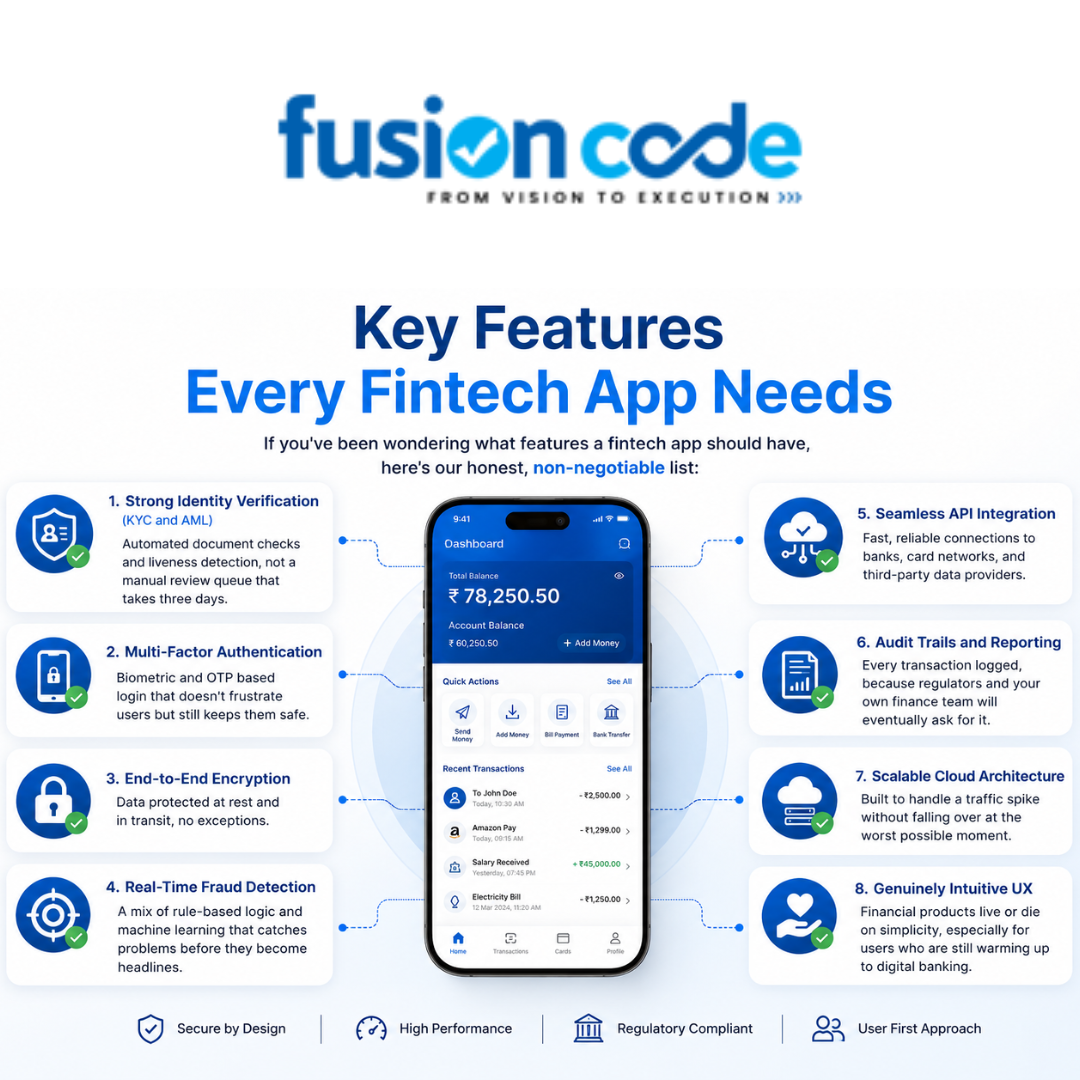
If you’ve been wondering what features a fintech app should have, here’s our honest, non-negotiable list:
- Strong identity verification (KYC and AML). Automated document checks and liveness detection, not a manual review queue that takes three days.
- Multi-factor authentication. A biometric and OTP-based login that doesn’t frustrate users but still keeps them safe.
- End-to-end encryption. Data is protected at rest and in transit, no exceptions.
- Real-time fraud detection. A mix of rule-based logic and machine learning that catches problems before they become headlines.
- Seamless API integration. Fast, reliable connections to banks, card networks, and third-party data providers.
- Audit trails and reporting. Every transaction is logged because regulators and your own finance team will eventually ask for it.
- Scalable cloud architecture. Built to handle a traffic spike without falling over at the worst possible moment.
- Genuinely intuitive UX. Financial products live or die on simplicity, especially for users who are still warming up to digital banking.
And then there’s fintech cybersecurity, which deserves its own mention because it’s so often treated as an afterthought. It can’t be. Threat modelling, encryption standards, and access controls need to be part of the system design from the first whiteboard session, not something you scramble to patch in right before launch. We build against the PCI Security Standards Council’s data security requirements as a baseline, not an afterthought, checked off before launch.
How Much Does Fintech App Development Cost?
Honestly? It depends. But let’s give you real numbers instead of a vague “it varies”.
- MVP e-wallet or basic finance app: Lower five figures (USD), covering core wallet functions, basic KYC, and a simple admin panel.
- Mid-complexity app with neobanking features, multiple payment rails, and custom dashboards: mid five to low six figures.
- Enterprise-grade platform, think loan management systems with multi-country compliance, advanced fraud detection, and high transaction volume: six figures and beyond.
A few things move that number more than anything else:
- Regulatory scope. A single market launch is far simpler than juggling compliance across multiple countries.
- Integration count. Every bank, gateway, and credit bureau you connect to adds real engineering work.
- Security requirements. Standard encryption versus a full PCI DSS or ISO 27001-aligned build is two very different projects.
- Custom versus modular development. Fully bespoke systems take longer and cost more than configuring proven modules.
We always start with a scoping phase that turns these variables into a clear, fixed estimate before a single line of code gets written. No surprises halfway through.
Why Businesses Choose Fusion Codes
- Financial-grade engineering discipline. We treat every wallet ledger like it has to survive an audit, because someday it will.
- Compliance-aware development. KYC, AML, and data protection get built in from the start, not stapled on at the end.
- Real API integration expertise. Banks, payment gateways, credit bureaus, identity verification providers – all of it.
- Cross-category experience. Wallets, neobanks, loan management systems, InsurTech, and embedded finance. We’ve built across the spectrum.
- Transparent, scoped delivery. Clear milestones and fixed estimates instead of open-ended billing that keeps climbing.
As a fintech development company in Lucknow working with clients across the globe, we combine cost efficiency with international delivery standards. In a funding environment where every rupee and every dollar has to work harder, that combination genuinely matters.
Frequently Asked Questions
What is fintech software development?
It’s the process of building software that handles financial transactions, money movement, and compliance requirements securely, whether that’s a wallet, a banking app, or a lending platform.
How much does fintech app development cost?
Costs typically range from the lower five figures for a basic MVP to six figures or more for enterprise-grade platforms, depending on regulatory scope, integrations, and security requirements.
What does a fintech software development company do?
It manages the full product journey: strategy, regulatory mapping, architecture, development, API integration, security testing, and ongoing support after launch.
What are fintech software solutions?
They’re software products that digitize financial services across payments, banking, lending, wealth management, and insurance, including the infrastructure like fraud detection and financial data analytics that hold it all together.
What are the benefits of fintech software development?
Faster transactions, lower operating costs, broader financial access for underserved users, real financial services automation, and the ability to launch new financial products without building an actual bank from the ground up.
What features should a fintech app have?
Strong KYC and AML checks, multi-factor authentication, encryption, real-time fraud detection, reliable API integration, audit-ready reporting, scalable infrastructure, and a user experience that doesn’t make people give up halfway through onboarding.
What is banking software development?
It’s the part of fintech development focused specifically on banking functions: account management, core banking systems, payment processing, and the compliance infrastructure that banks and neobanks are legally required to maintain.
Ready to Build Something That Actually Holds Up?
Fintech isn’t a space where you move fast and fix things later. Get security or compliance wrong, and there’s no quiet patch release that fixes it. Fusion Codes builds e-wallets, neobanking platforms, loan management systems, and custom fintech applications designed to scale safely from the very first user.
If you’re ready to talk through your product, get in touch with the Fusion Codes team, and let’s scope it out together.