Mobile and DTH recharge brings customers into a shop, but it rarely keeps a retailer’s business healthy. Margins on a prepaid recharge are usually a few percent; every app on the customer’s phone offers the same thing, and loyalty is close to zero.
Picture a busy morning at a small shop. A pensioner wants ₹2,000 from her account and has only her thumb to prove who she is. The family next door needs to clear last month’s electricity bill before the connection is cut. A mason from Bihar wants to send his weekly wages home. None of them is comparing apps. They go back to the shop that helped them last time, and that is why AEPS, BBPS and DMT now sit at the centre of most retailer and distributor networks in India.
This guide takes the three services one at a time. For each, you’ll see how it works and how retailers and distributors get paid. After that, we get into the less exciting but important part, compliance and bank tie-ups, and finish with our take on which service to launch first.
What Is AEPS (Aadhaar Enabled Payment System)?
AEPS, run by NPCI, turns a local shop into a place where people can use their Aadhaar-linked bank account. The customer doesn’t need an ATM card or a PIN, and doesn’t even need a smartphone. A fingerprint is enough. RBI calls the retailer doing this an AEPS Touchpoint Operator (ATO), and every ATO is onboarded by an acquiring bank.
How an AEPS transaction works
- The retailer opens AEPS in the app or web portal and chooses what the customer wants. Nine times out of ten, that’s cash withdrawal.
- The customer tells the retailer their Aadhaar number and which bank their account is with.
- Once the amount is entered, the customer puts a finger on the certified biometric scanner.
- UIDAI matches the encrypted fingerprint, then NPCI sends the request to the customer’s bank.
- The bank takes the money from the customer’s account and adds it to the retailer’s wallet or settlement account.
- The retailer counts out the cash. The customer leaves with a slip or an SMS.
With a clean fingerprint read, it’s done in less than a minute. Worn fingertips can mean a few retries, which we cover in the risks section.
Services offered through AEPS
- Cash withdrawal: the main reason people walk in, and the service that earns the retailer most of their AEPS commission.
- Balance enquiry: lots of customers check first, particularly around the dates benefits are paid.
- Mini statement: lists the account’s last few entries. Useful when someone keeps asking whether their DBT money has arrived.
- Aadhaar Pay: here the customer doesn’t take cash at all. They pay the shopkeeper for what they’re buying, using their fingerprint.
A few platforms go further with cash deposit and Aadhaar-to-Aadhaar transfer. Whether you get these depends on your acquiring bank.
Hardware needed: certified biometric devices and RD service
AEPS only works with a UIDAI-certified Registered Device (RD), connected to an Android phone, tablet or PC. The RD service is the driver software that encrypts and signs the fingerprint before it leaves the device.
UIDAI has been retiring older L0 fingerprint devices in favour of L1 devices, which encrypt and sign the fingerprint on the scanner chip itself. Its March 2025 letter set 30 June 2025 as the final L0 sunset date, so any L0 scanner still on a counter has to be replaced. Device maker Mantra also reports that NPCI has stopped face authentication for AEPS cash withdrawal and Aadhaar Pay. In practice, that leaves a working fingerprint or iris device as the only option.
Set aside money for one L1 fingerprint scanner per outlet. Then keep its RD service updated, because an old driver throws errors even when the hardware itself is certified.
Who uses AEPS and why it matters
AEPS does best where the nearest ATM is a bus ride away. The usual customers are pensioners, MGNREGA workers, farmers getting PM-Kisan or other DBT money, and Jan Dhan account holders, many of them women, who were never given a debit card.
For them, getting cash from the shop down the road can save half a day. For the retailer, it means the same faces every month when benefits are credited, and they rarely leave with only cash in hand.
What Is BBPS (Bharat Bill Payment System)?
BBPS is the bill payment network designed by RBI and run by NPCI Bharat BillPay Limited (NBBL). Since 2024, it has officially been called Bharat Connect, though most retailers still say BBPS. Either way, it lets one counter take payment for almost every regular bill a household gets.
How BBPS works, and why one connection covers thousands of billers
The easiest way to picture BBPS is as a hub. Billers, whether it’s the state electricity board, a gas company or a lender, join through a Biller Operating Unit (BOU). The people collecting payments, meaning banks, apps and retailer networks like yours, join through a Customer Operating Unit (COU). NBBL runs the middle: it routes each payment, settles the money, and deals with complaints.
Because every biller follows the same standards, one BBPS integration on your platform gives your retailers access to the whole network. NPCI data shows 22,722 billers live on Bharat Connect in Q2 of FY 2026-27 (Jul–Sep 2026).
A typical bill payment looks like this:
- The retailer selects the category and biller, then enters the customer’s consumer number.
- The platform fetches the live bill amount and due date from the biller.
- The customer pays the retailer in cash or UPI.
- The payment is posted to the biller in real time, and the customer receives a BBPS receipt with a reference number.
Bill categories retailers can offer
The Bharat Connect category list spans utilities, financial payments, and subscriptions. The ones that matter most at a retail counter are:
- Electricity and prepaid meters
- Water and municipal taxes
- Piped gas and LPG booking
- FASTag recharge
- Loan repayment and EMIs
- Insurance premiums
- Broadband, landline and postpaid mobile
- DTH and cable TV
Loan repayment deserves a special mention. It covers hundreds of lenders, so in districts where microfinance and NBFC loans are common, EMI collection alone can keep a BBPS counter busy.
How BBPS differs from a regular recharge API
A recharge API connects you to telecom and DTH operators, usually through a private aggregator, and the customer chooses an amount to top up. BBPS is a regulated network where the amount comes from the biller and the payment is a settlement of a real bill.
You feel the difference in day-to-day work. Because BBPS fetches the bill from the biller, the retailer isn’t typing in an amount and getting it wrong. If something does go wrong, there’s a standard reference number and NBBL’s complaint process to fall back on, so disputes get sorted faster. And a customer who pays electricity, gas and an EMI at your counter is in the shop several times a month, which a recharge-only customer rarely is.
What Is DMT (Domestic Money Transfer)?
DMT lets a customer walk into a shop with cash and send it to any bank account in India. The retailer collects the cash, and the transfer goes out through IMPS or NEFT from a bank’s system, with the retailer working as part of a bank’s Business Correspondent (BC) network.
Who needs DMT
UPI has cut into DMT in the cities. Outside them, plenty of people still walk up to a counter with cash in hand:
- Migrant workers: people on construction sites, in factories and in hotels, sending a share of their pay home each week or month.
- People without a bank app: some have only a basic phone, some find apps hard to use, and some never set up net banking.
- Cash-first customers: they’re paid in cash and don’t want to queue at a branch to deposit it before sending it on.
For these customers, DMT is a habit. A retailer near a labour colony or industrial area can see the same remitters several times a month.
The transfer flow
- Remitter registration: done once. The customer is registered with a verified mobile number and an identity document.
- Adding a beneficiary: the retailer enters the receiver’s name, account number, and IFSC. On most platforms, a penny-drop check confirms the name on the account.
- OTP or authentication: before the money goes, the remitter approves it with an OTP or another authentication factor.
- Transfer: money goes out over IMPS, which is instant, or NEFT, which moves in batches. Sender and receiver both get a confirmation.
Once a beneficiary is saved, the next transfer is quick, usually a minute or two.
Tighter KYC rules for cash-based transfers
RBI revised the DMT framework through its July 24, 2024 circular, effective November 1, 2024. For cash pay-in, banks and BCs must register remitters using a verified mobile number and a self-certified Officially Valid Document under RBI’s KYC Master Direction.
Each transaction also needs a second authentication factor now. The IMPS or NEFT message has to include the remitter’s details and a tag showing the transfer started as cash. On top of that, banks and BCs have to stay within Income Tax Act rules on cash deposits. The per-transaction and monthly caps set in 2011 still stand, but ask your sponsor bank for the exact numbers it applies.
These rules change. In January 2026, Business Standard reported that RBI was considering a licensing regime for corporate BCs after seeing agents flout DMT limits. Before launching or scaling DMT, check RBI’s notifications page for the latest circulars.
AEPS vs BBPS vs DMT at a Glance
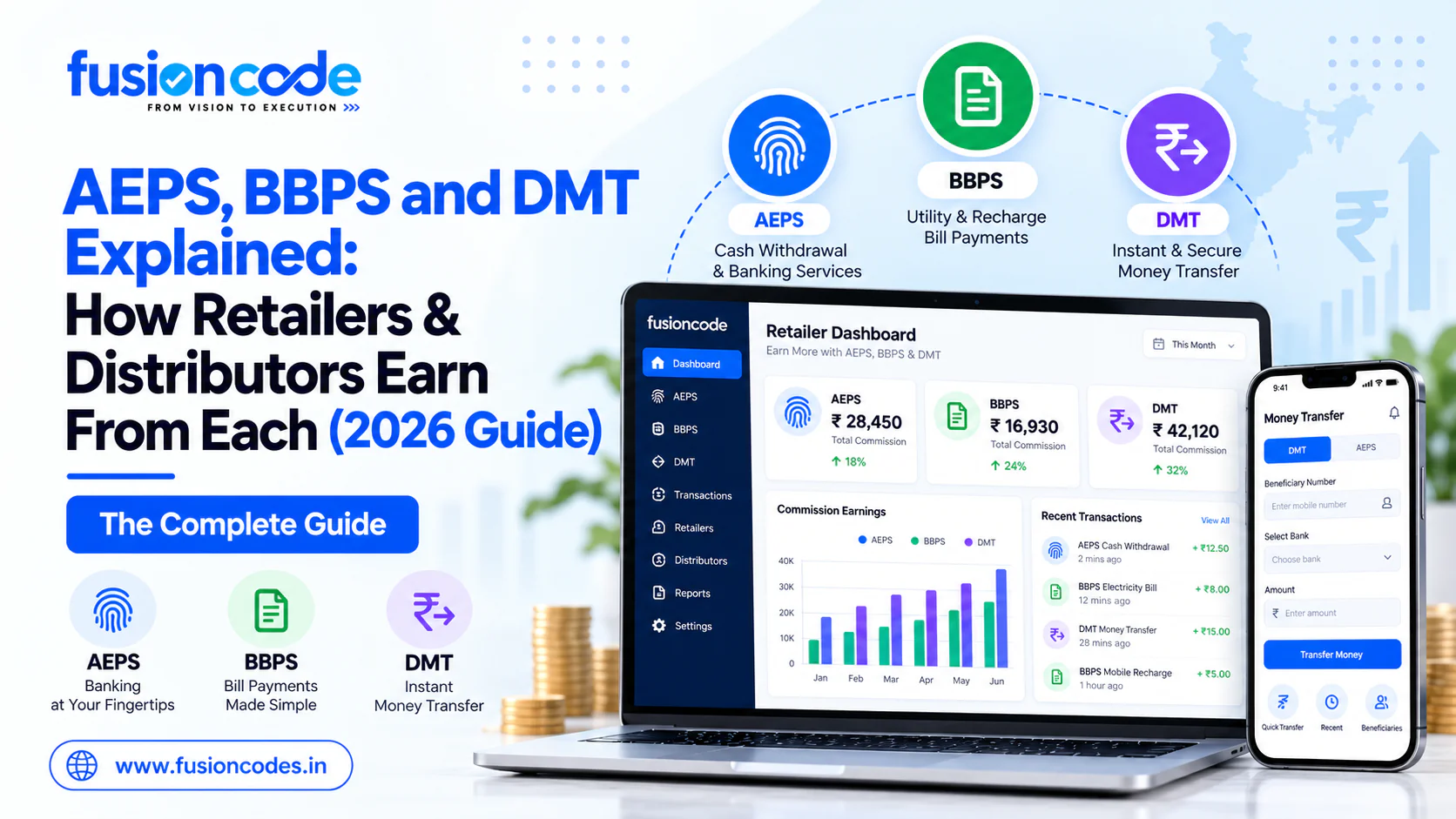
AEPS needs the most hardware, BBPS has the lightest compliance, and DMT carries the most fraud risk. The three tables below compare them side by side.
What the customer gets and how the retailer earns
| Service | What the customer gets | How the retailer earns |
|---|---|---|
| AEPS | Cash from their bank account, balance, mini statement | Commission per withdrawal, by amount slab |
| BBPS | Bills paid on time with an official receipt | Per-bill commission or flat rate, varying by biller |
| DMT | Cash sent to any bank account in India | Share of a customer fee (surcharge) on transfer value |
Hardware and compliance
| Service | Hardware needed | Compliance burden |
|---|---|---|
| AEPS | UIDAI-certified L1 biometric scanner + phone or PC | High: acquiring bank onboarding, operator due diligence, device registration |
| BBPS | Phone or PC only | Low to medium: access through an authorised operating unit |
| DMT | Phone or PC only | High: BC tie-up, remitter KYC, extra authentication, cash limits |
How often customers come back, and where each service fits
| Service | Transaction frequency per customer | Best fit |
|---|---|---|
| AEPS | Monthly, peaking around benefit and salary credits | Villages and small towns with few ATMs |
| BBPS | Several times a month across bill types | Urban and semi-urban households |
| DMT | Weekly or monthly, tied to wage cycles | Areas with many migrant workers |
How Earnings Work for Each Service
No two of these services pay the same way. AEPS earns on the number of withdrawals, DMT on how much is sent, and BBPS on how often customers come back. Offer all three, and you’re not relying on a single income stream. Actual rates come from the sponsor bank, the BBPS operating unit, and your platform, and they get revised from time to time.
AEPS: commission per withdrawal slab
The more a customer withdraws, the more the retailer usually earns. Platforms set this up in slabs: say, one rate up to ₹1,000, a better rate up to ₹3,000, and a fixed maximum beyond that. Balance enquiries and mini statements pay very little, sometimes nothing, but a customer who checks their balance often withdraws right after. Aadhaar Pay is priced separately, closer to a merchant payment.
BBPS: per-bill commission or flat rate
BBPS commission depends on the biller and category. Some billers pay a small fixed amount per bill, others a percentage of the bill value, and some categories pay very little. Loan repayments and insurance tend to pay better than electricity, but electricity brings the most footfall. Any customer convenience fee must follow BBPS rules and be shown to the customer.
DMT: surcharge on transfer value
DMT usually charges the customer a fee based on the amount sent, often a percentage with a minimum per transaction. That fee is split between the bank, the platform and the network, and the retailer keeps a share. Because DMT earns on value, a few large transfers can outweigh many small AEPS or BBPS transactions.
Worked example: one retailer, one day (illustrative)
This example is illustrative only. The rates and volumes below are assumptions chosen to show the arithmetic. They are not actual rates from any bank or platform, and they are not a promise of earnings.
| Service | Assumed volume and earnings per transaction | Illustrative daily earnings |
|---|---|---|
| AEPS cash withdrawal | 20 withdrawals (average ₹2,500) × ₹6 | ₹120 |
| BBPS bill payments | 15 bills × ₹2 | ₹30 |
| DMT transfers | 8 transfers (average ₹4,000) × ₹24, a 60% share of a 1% fee | ₹192 |
| Total | 43 transactions | ₹342 |
Look at how the numbers fall in this example. DMT makes the most money from just eight transactions. AEPS keeps the counter busy all day. BBPS pays the least per bill, yet it’s the one that brings customers back most often. Your own split will look different, depending on where your shop is, who your customers are, and what your platform pays.
How income is distributed across distributor levels
Every transaction’s margin is split down the network. The platform keeps its share and passes a set commission to each level, typically from super distributor to distributor to retailer, based on the commission plan configured in the admin panel. How those levels, plans, and payout rules are set up is covered in detail in our Recharge App Development guide, and the same structure applies to AEPS, BBPS, and DMT.
Compliance and Partnerships You Need
Here’s the part many new distributors underestimate. You can’t run AEPS, BBPS, or DMT on your own licence. Every transaction passes through a regulated partner, and your software is simply the bridge to them. If their compliance slips, so does yours.
Sponsor bank or BC network tie-up for AEPS and DMT
AEPS and DMT move real money in and out of bank accounts, so a bank has to stand behind them. In most cases, you won’t deal with that bank directly. You’ll plug into a corporate Business Correspondent or an API provider that already has a sponsor bank on board. For AEPS, that bank is the acquiring bank. For DMT, it’s the remitting bank. Either way, it decides your transaction limits, your commission, and how retailers get onboarded.
The rules got stricter in 2025. Under RBI’s June 27, 2025 direction on AEPS touchpoint operators (RBI/2025-26/63), the acquiring bank now has to verify every operator the same way it would verify a new customer for KYC. It also has to keep watching each outlet, looking at things like where it operates, how many transactions it runs, and how fast. What this means on the ground: more paperwork when you onboard a retailer, and lower limits for new outlets or ones that look risky.
BBPS access through an authorised operating unit or aggregator
To collect bills, you need access through a Customer Operating Unit, usually a bank or an RBI-authorised non-bank BBPS entity. Most retail networks reach one through an aggregator or API provider registered as an agent institution, rather than applying directly. Your retailers then become BBPS agents under that unit.
Retailer KYC, device registration and transaction limits
At the retailer level, plan for:
- Retailer KYC: PAN, Aadhaar, shop details, bank account, and often a shop photo or geo-tagged location.
- Device registration: each AEPS outlet links its L1 biometric device serial number to its account.
- Daily login authentication: many banks require the operator to authenticate with their own fingerprint before doing AEPS transactions.
- Transaction limits: per-transaction, daily and monthly caps per customer and per outlet, set by NPCI, RBI and the bank.
Verify current rules before you launch
NPCI, RBI and UIDAI update these rules several times a year. Before launching any service, ask your sponsor bank for its current onboarding checklist and check the RBI notifications page and NPCI circulars for recent changes. This guide reflects the rules as of October 2026 and is not legal advice.
Risks and Common Problems
Most retailer complaints about banking services come down to four problems: failed fingerprints, stuck transactions, fraud, and slow settlement. Good software doesn’t remove these risks, but it handles them before they become disputes.
Biometric failures and pending AEPS transactions
Fingerprints fail often among farmers, labourers and elderly customers whose fingertips are worn. A dirty sensor, an outdated RD driver, or a weak network adds to the failures. The worse problem is a pending transaction, where the customer’s account is debited but the retailer’s wallet isn’t credited, or the response times out.
How software handles it: automatic status checks against the bank until a final response arrives, auto-reversal of failed debits within the bank’s timeline, clear on-screen error codes, and a rule that no cash is handed over until the transaction shows success.
DMT fraud patterns and mule accounts
DMT attracts fraud because it turns cash into an untraceable-looking bank transfer. Common patterns include one remitter sending to many unrelated beneficiaries, many remitters sending to the same account, transfers split to stay under limits, and beneficiaries that are mule accounts used to move scam proceeds. If a retailer’s outlet is linked to mule activity, the sponsor bank can freeze the outlet and the funds.
How software handles it: penny-drop name matching on every new beneficiary, velocity rules per remitter, beneficiary and outlet, blocks on accounts flagged by the bank, alerts on unusual patterns, and limits that cannot be bypassed by splitting transactions.
Settlement delays and reconciliation disputes
When bank settlement, platform wallet, and retailer ledger don’t match, every level of the network loses trust. Delays happen around bank holidays, partner downtime, and transactions stuck in a pending state.
How software handles it: daily reconciliation that matches bank reports to platform records, a single transaction reference across all three systems, a dispute ticket flow linked to the original transaction, and settlement reports that each distributor and retailer can download.
Which Service Should You Add First?
Start with the service your retailers’ customers already ask for, then add the other two once the first is running smoothly.
| If most of your retailers are in… | Start with | Why |
|---|---|---|
| Cities and large towns | BBPS | Households pay many bills, smartphones are common, no extra hardware, and compliance is the lightest |
| Villages and small towns | AEPS | Few ATMs, many benefit and pension accounts, and cash withdrawal is the most-used service |
| Industrial areas, labour colonies, construction hubs | DMT | Migrant workers send wages home regularly and prefer to pay in cash |
Mixed networks can start with BBPS across all outlets, since it needs no hardware, and roll out AEPS to rural outlets as devices arrive.
Why bundling all three on one platform increases retailer stickiness
A retailer who uses one app for recharge, another for AEPS and a third for DMT is always comparing rates and can leave any of them easily. Put all three on one platform with one wallet, one login, and one ledger, and switching becomes a real cost for them.
Bundling also helps the retailer’s own customers. The person who withdraws cash through AEPS can pay their electricity bill and send money home in the same visit. More services per customer means more transactions per outlet, which is what keeps retailers active and distributors earning.
What to Look for in AEPS/BBPS/DMT Software
The right AEPS software is judged on how it handles these three services specifically, not on its recharge features. Check these five areas before you choose a platform.
- Biometric device support: works with the major UIDAI-certified L1 fingerprint and iris devices on Android and Windows, detects the RD service status, and tells the retailer clearly when a driver needs updating. It should also support operator daily authentication if your bank requires it.
- BBPS biller sync: pulls the live biller list, categories, and input fields from the operating unit automatically, so new billers appear without an app update. Bill fetch, BBPS receipts, and complaint registration should be built in.
- DMT beneficiary validation: remitter registration with OTP and document capture, penny-drop name checks on new beneficiaries, saved beneficiaries for repeat transfers, and IMPS/NEFT fallback when one rail is down.
- Fraud and risk rules: configurable limits and velocity checks per customer, beneficiary, retailer, and distributor; device and location checks; and the ability to suspend an outlet instantly. These rules should be editable from the admin panel without new code.
- Settlement and reconciliation reports: daily reports that match bank settlement to platform records, service-wise commission statements for every level, pending-transaction tracking and downloadable dispute records.
For general platform features such as wallet management, user hierarchy and white-label branding, see our Recharge App Development guide. To see how these banking features work together, visit our AEPS, BBPS and DMT platform page.
FAQs
Is a licence required to start an AEPS business?
A retailer doesn’t need its own RBI licence to offer AEPS. You operate under an acquiring bank, usually through a corporate Business Correspondent or API partner, and that bank must complete due diligence on you before onboarding. You will need KYC documents, a certified L1 biometric device, and registration with the partner.
How much commission does an AEPS retailer earn?
AEPS commission is paid per cash withdrawal and usually rises with the withdrawal amount in slabs. The exact rates depend on your sponsor bank, platform, and position in the distributor hierarchy, and they change from time to time. Ask your platform for its current commission chart before you start.
What is the difference between BBPS and a recharge API?
A recharge API tops up prepaid mobile or DTH accounts with an amount the customer chooses. BBPS is an RBI-regulated network run by NBBL that fetches and pays real bills from over 22,000 billers, with standard receipts and a central complaint process.
Is DMT still allowed after the recent RBI changes?
Yes. RBI’s revised framework, effective November 1, 2024, keeps cash-based DMT but adds stricter KYC: remitters must be registered with a verified mobile number and an identity document, and each transaction needs extra authentication. Check RBI’s latest circulars and your sponsor bank’s rules, as the framework continues to evolve.
Can I offer AEPS, BBPS and DMT through one app?
Yes. A single platform can connect to an AEPS/DMT banking partner and a BBPS operating unit, and give retailers one login, one wallet, and one ledger for all three services. Bundling them usually raises transactions per outlet and makes retailers less likely to switch platforms.
Conclusion
AEPS, BBPS and DMT turn a recharge counter into a neighbourhood banking point. AEPS brings cash-withdrawal customers in villages, BBPS brings repeat bill payers in towns and cities, and DMT brings migrant workers who send money home every month. Each pays differently, carries its own compliance and risks, and works best when your software handles failures, fraud and reconciliation for you.
Pick the service that fits your retailers’ customers, launch it with a compliant banking partner, and add the other two on the same platform as your network grows.
Want to see AEPS, BBPS and DMT running on one platform? Book a free demo on WhatsApp and we’ll walk you through the retailer app, the admin panel and the commission setup. You can also explore the full feature list on our AEPS, BBPS and DMT platform page.