
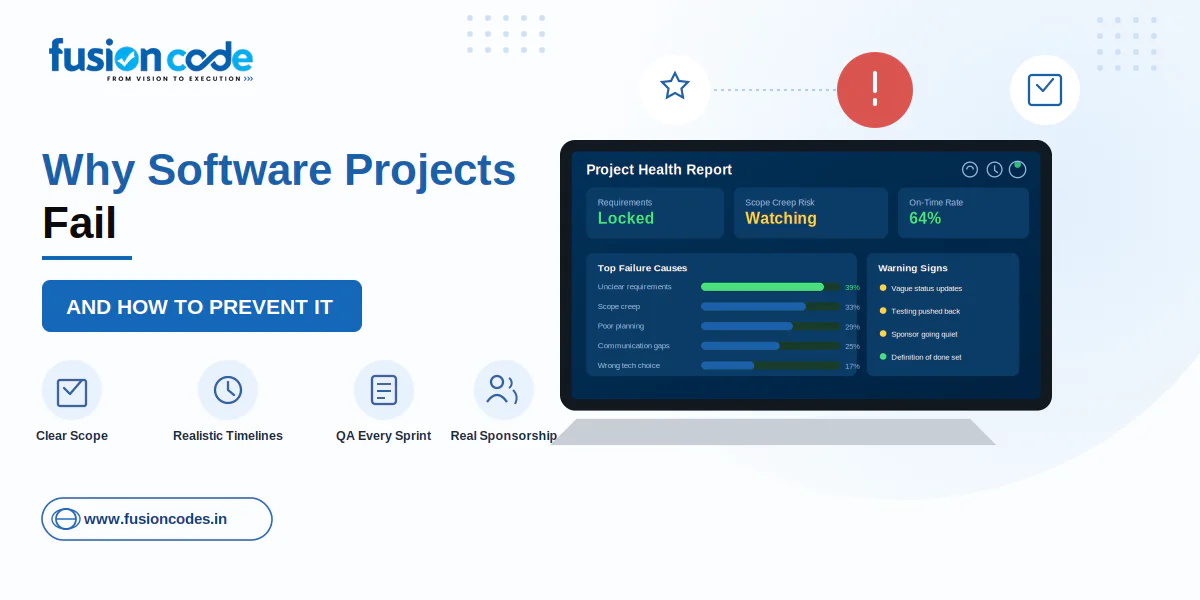
Ask most businesses what could sink their software project. They’ll usually point to technology. Wrong stack, wrong framework, something technical.
The data tells a different story. Decade after decade of industry research keeps landing on the same handful of root causes. Unclear requirements. Scope creep. Poor planning. These show up again and again, no matter what tech stack sat underneath the failed project.
This guide covers the most common software project failure reasons. It explains why software development projects fail even at experienced companies. It looks at what the real failure rates actually show. And it covers how Fusion Codes structures its own projects to dodge these exact patterns.
What Is Software Project Failure?
A software project fails when it can’t deliver its agreed scope. Or when it misses budget and timeline by a wide margin. Or when it gets cancelled before anyone finishes it.
Failure doesn’t always mean total collapse. A project can ship late, run over budget, and arrive missing half its planned features. That still counts as failure, even though something technically got delivered.
What Does It Mean When a Software Project Fails?
Three patterns cover most failed projects. Cancelled outright before delivery. Delivered, but missing real scope or quality. Or delivered so far past budget and timeline that the original business case stopped making sense somewhere along the way.
Each pattern costs something different. All three cost real time, real money, and a fair bit of trust inside the organisation.
What Percentage of Software Projects Fail?
The Standish Group’s CHAOS Report has tracked this since 1994. It remains the most cited research on the topic, spanning tens of thousands of projects.
Its latest numbers put roughly 40 percent of software projects short of their original goals. Another 19 percent get cancelled outright before anything ships.
| Outcome | Approximate Rate |
|---|---|
| Successful (on time, on budget, full scope) | 30 to 31 percent |
| Challenged (delivered late, over budget, or reduced scope) | 49 to 50 percent |
| Failed or cancelled outright | 19 to 21 percent |
Worth flagging: the CHAOS Report’s methodology has taken real academic heat over the years. Eveleens and Verhoef’s 2010 analysis in IEEE Software argued some of the report’s definitions inflate failure rates on paper. Even with that critique in mind, plenty of independent sources still land on the same basic picture: a sizable chunk of software projects miss their original goals.
Why Do Most IT Projects Fail?
Organisational and planning problems, not purely technical ones. Weak requirements gathering. Thin executive sponsorship. Timelines nobody actually believed in from the start. These consistently beat out coding mistakes or bad tech choices once a project actually falls apart.
Why Do Software Projects Fail?
What Is the Most Common Cause of Software Project Failure?
Unclear or incomplete requirements sit at the top of nearly every list, cited in around 39 percent of failed projects per recent Standish Group and PMI research. Build against requirements that are vague or contradictory, and the finished product rarely matches what the business actually wanted in the first place.
What Are the Main Reasons for Software Project Failure?
| Cause | Approximate Share of Failed Projects |
|---|---|
| Unclear or incomplete requirements | 39 percent |
| Scope creep | 33 percent |
| Inadequate planning | 29 percent |
| Communication breakdowns | 25 percent |
| Poor technology choices | 17 percent |
These numbers come from the combined Standish Group CHAOS Report and PMI Pulse of the Profession research. The pattern barely shifts year over year.
10 Reasons Why Software Projects Fail and How to Fix Them
- Unclear requirements, fixed through structured discovery workshops and written sign-off before anyone starts coding
- Scope creep, fixed with a formal change request process instead of quietly adding scope mid-sprint
- Inadequate planning, fixed by grounding estimates in similar past projects rather than optimistic guessing
- Weak communication, fixed through regular, structured check-ins instead of scattered ad hoc updates
- Poor testing, fixed by building QA into every sprint instead of saving it for the final week
- Security treated as an afterthought, fixed by pulling security review into the architecture stage
- Unrealistic timelines, fixed by padding for the unknowns every project genuinely runs into
- Lack of executive sponsorship, fixed by keeping a real decision-maker actively involved, not just cc’d on emails
- Wrong technology choices, fixed by picking tools for the problem at hand, not just team comfort
- No clear definition of done, fixed by agreeing upfront on what “finished” actually means per feature
How Unclear Requirements Cause Software Project Failure
Leave requirements vague, and everyone fills the gaps with their own guess. Those guesses rarely line up. A developer builds one version of the idea, a stakeholder pictured another, and nobody notices the mismatch until the feature’s already built. Fixing it at that point costs a lot more than getting it right on the first pass would have.
How to Write Realistic Software Development Estimates
Small, comparable pieces- that’s how the work should get broken down first. Then check each piece against how similar work has actually gone in the past, not against a gut feeling that happens to sound optimistic. Real contingency time matters too, for testing, for review cycles, for whatever integration surprise inevitably shows up. Do it this way, and the estimate tends to survive contact with reality a lot better than some confident number someone pitched during a sales call.
How Scope Creep Affects Software Project Budget and Timeline
Scope creep works quietly. Work gets added bit by bit, and neither the budget nor the timeline gets touched to match. What looked achievable at the start slowly becomes something the original numbers can’t actually support anymore.
Each addition feels small and reasonable on its own. Add them up, though, and a project can end up carrying two or three times its original scope while still measured against day-one deadlines.
How to Manage Changing Requirements in Software Projects
Change happens. Pretending otherwise doesn’t help anyone. Managing it well means running every requested change through a real process, logged, estimated for its actual timeline and cost impact, and approved explicitly before work starts. Not absorbed silently into a schedule that was never built to hold it.
How Poor Testing Leads to Software Project Failure
Skip proper testing and bugs slip straight past development into production. Costs more to fix them there, obviously. There’s a quieter cost too: user trust erodes fast once people start relying on a system that keeps breaking on them. Squeeze testing into one rushed final step and it’ll catch the obvious stuff, sure, but the subtler issues, the ones real users actually stumble into, sail right through.
Why Security Is Often an Afterthought in Software Development
A stakeholder can’t really see security in a demo, not the way they see a button or a screen. Under deadline pressure, teams end up chasing whatever’s visible instead, understandably, which is exactly the argument for pulling security into the architecture stage from day one. Wait for a rushed audit right before launch, and a fundamental design flaw costs a lot more to fix than it ever would have if someone caught it early.
Why Do Software Projects Fail Even With Good Developers?
Even great developers can’t fix unclear requirements on their own. Or an unrealistic deadline. Or a client changing direction halfway through the build. Technical skill solves technical problems, sure, but most software project failures come from organisational and communication issues sitting well outside any one developer’s control.
Common Causes of Software Project Failure: Management Mistakes
Software project management mistakes rank among the most common causes of project failure in software engineering. They tend to pile on top of the root causes above rather than existing as their own separate problem.
- Treating the original estimate as fixed, even once scope has clearly grown past it
- Dodging hard conversations about timeline slippage until hiding it isn’t possible anymore
- Skipping structured risk assessment right at the project’s outset
- Losing genuine executive sponsorship somewhere along the way
- Measuring progress by hours logged instead of features actually working
Software Project Risks: Early Warning Signs
Software project risks rarely show up out of nowhere. A handful of early warning signs that a software project is failing tend to surface well before a launch date actually slips.
- Requirements keep shifting with no formal change control catching any of it
- Status updates go vague, “mostly on track” instead of anything specific or measurable
- Testing keeps sliding later in the schedule to protect the launch date
- Key stakeholders stop showing up to review meetings
- Nobody on the team can clearly say what “done” looks like for the current milestone
How to Prevent Software Project Failure?
Knowing how to avoid software project failure mostly means catching the same root causes early, before they stack up into something nobody can walk back.
- Spend real time on requirements gathering before writing a single line of code
- Set up a formal, lightweight change request process starting day one
- Build testing into every sprint instead of treating it as a final gate
- Keep a genuine executive sponsor engaged the whole way through, not just at kickoff and launch
- Track progress against working, demonstrable features, not hours logged or lines written
How to Create a Definition of Done for Software Teams
Spell out exactly what a feature needs to hit before it counts as finished. Coded. Tested. Reviewed. Documented. Signed off by a stakeholder. Not just running on a developer’s own laptop. Agree on this before development even starts, and a huge source of later disagreement just disappears- the kind where one side thinks a feature’s done and the other doesn’t.
How Do You Rescue a Troubled Software Project?
- Pause new feature work and get an honest read on what actually exists and what’s left
- Re-establish clear, written requirements for anything still ambiguous or contested
- Renegotiate timeline and budget against the real remaining scope, not the original estimate
- Put a real change control process in place if one was never there to begin with
- Bring in a genuinely engaged decision-maker if executive sponsorship quietly slipped away
- Ship a smaller working milestone fast, to rebuild stakeholder confidence before tackling the rest
Real-World Examples of Software Project Failures
A handful of widely documented real-world examples of software project failures make these root causes easy to see. The original Denver International Airport baggage handling system, one of the CHAOS Report’s most cited historical cases, ran into unrealistic scope and timeline pressure, pushing the airport’s opening back by over a year. The FBI’s Virtual Case File system got cancelled after roughly 170 million dollars spent, largely down to requirements that kept shifting and planning that never quite caught up. The UK’s NHS National Programme for IT was eventually dismantled after billions in cost overruns, still cited today as a case study in scope and governance failure at national scale.
Lessons Learned from Failed Software Projects
The same lesson keeps repeating across nearly every well-documented failure. Technical execution rarely brings a project down on its own. Unclear requirements, unmanaged scope changes, and weak governance do far more damage than any single coding mistake or technology limitation ever manages to.
Software Development Project Failure Rate by Methodology
| Methodology | Approximate Success Rate |
|---|---|
| Agile | 64 percent |
| Waterfall | 49 percent |
Agile’s iterative feedback loops tend to catch misaligned requirements and drifting scope earlier than Waterfall’s upfront, all-at-once planning ever does. That gap shows up consistently across the CHAOS Report’s methodology comparisons, year after year.
Fusion Codes: Building Software Projects That Don’t Become a Statistic
Fusion Codes builds every software project around the exact failure patterns covered in this guide, starting with structured discovery and written requirements sign-off before a single line of code gets written. We bring over ten years of combined domain and technology experience to these builds, operating under ISO 9001, ISO 27001, ISO 20000, and ISO 22301 certifications- the same kind of disciplined process control that keeps a software project from drifting into the patterns above.
Every project runs through iterative sprints with a real definition of done agreed on upfront, formal change control for anything that shifts mid-project, and QA built into each sprint rather than saved for one rushed pass right before launch.
For official research on project management practices and risk factors across industries, PMI’s Pulse of the Profession research offers ongoing, widely cited data on project outcomes. For security practices that belong in the architecture stage rather than bolted on at the end, OWASP’s official resources remain the standard reference for secure software development.
Frequently Asked Questions
What is software project failure?
A project that fails to deliver its agreed scope, misses its budget or timeline by a significant margin, or gets cancelled before completion, whether or not something eventually ships.
What does it mean when a software project fails?
It usually falls into one of three patterns: cancelled outright, delivered with real gaps in scope or quality, or delivered so far past budget and timeline that the original business case no longer holds.
Why do software projects fail?
Most often because of unclear requirements, scope creep, inadequate planning, and communication breakdowns- organisational and process issues far more than pure technical failure.
What is the most common cause of software project failure?
Unclear or incomplete requirements, cited in around 39 percent of failed projects according to combined Standish Group and PMI research.
What percentage of software projects fail?
Roughly 40 percent fail to fully deliver on original objectives, with about 19 to 21 percent cancelled outright, according to the Standish Group CHAOS Report.
Why do most IT projects fail?
Mostly organisational and planning issues, poor requirements gathering, weak executive sponsorship, and unrealistic timelines, rather than purely technical problems.
What are the main reasons for software project failure?
Unclear requirements, scope creep, inadequate planning, communication breakdowns, and poor technology choices consistently top the list across years of industry research.
How can software project failure be prevented?
By investing in real requirements gathering upfront, running formal change control, building testing into every sprint, and keeping genuine executive sponsorship engaged throughout.
How do you rescue a troubled software project?
Pause new feature work, get an honest read on current status, re-establish clear requirements, renegotiate timeline and budget realistically, and ship a smaller working milestone to rebuild confidence.
Ready to start a software project built to dodge these exact failure patterns? Reach out to Fusion Codes for a discovery conversation grounded in realistic scope, timeline, and process from day one.