Okay, so here’s the thing nobody tells you when you’re searching for a web development company in Lucknow.
Half the results you see are guys working from a laptop in their bedroom who learnt WordPress last year. A quarter of agencies will outsource your project to someone cheaper the moment you sign the contract. And the remaining few? Those are the ones actually worth talking to.
We’re FusionCodes. We’ve been building websites and web applications for businesses in Lucknow long enough to know exactly what goes wrong, why it goes wrong, and how to not let it happen to you.
This blog is not going to be the usual “here are 10 reasons why you need a website in 2026” type of content. You already know you need a website. What you probably don’t know is what separates a website that quietly generates business for you from one that just sits there collecting dust on a server.
That’s what we’re going to talk about.
What a Web Development Company in Lucknow! Actually Does
People come to us thinking web development is basically just making things look nice on a screen. It’s not. Or rather, that’s maybe 20% of what actually matters.
Think about the last time you landed on a website that felt off. Maybe it loaded slowly. Maybe you couldn’t figure out how to contact them. Maybe it looked fine on your laptop but turned into a mess on your phone. You probably left within 30 seconds and didn’t come back. That business lost you, and they have no idea why.
A professional website development company in Lucknow handles the whole picture. Not just the visual design but also the structure underneath it, the speed at which pages load, how easily Google can read and rank the content, whether the site works on every device, whether it’s secure, and whether it actually converts visitors into enquiries or purchases.
At FusionCodes, a typical project starts with us asking you uncomfortable questions. Things like who exactly is coming to this website and what are they hoping to find? What’s making you lose customers right now? What does your competition do better online than you do? Where do you want this business to be in two years?
Your answers change everything about how we build. A coaching institute in Lucknow needs a completely different website architecture than a B2B packaging manufacturer. A doctor’s clinic needs different things than a real estate developer. Anyone who shows you the same template proposal without asking these questions first is not someone you want building your business’s digital shopfront.
MDN Web Docs is genuinely the best place to understand how websites actually work under the hood, written by the people who help maintain the open web.
Web Development Services in Lucknow at FusionCodes
Here’s what we actually do, without the fluffy agency-speak.
Custom Website Development Lucknow: Built from scratch. No templates. No page builders. No, “we found a theme that’s close enough.” Every project starts with a blank canvas and ends with something that exists nowhere else.
E-Commerce Development: We build stores that are fast, easy to navigate, and don’t make people abandon their carts out of frustration. Secure payments, smart inventory management, and checkout flows that actually close the sale.
Corporate Websites: If your company is pitching to serious clients or investors, your website needs to look like it belongs in that room. We build corporate sites that communicate authority before a single word is read.
CMS-Based Websites: Sometimes your team needs to update content regularly without calling us. We build on platforms like WordPress and Strapi with custom setups, so you get flexibility without sacrificing performance.
Web Application Development: Booking systems, customer dashboards, SaaS tools, internal portals. If it’s more than a website and needs real functionality, we build it.
Landing Pages: One goal. One page. We build landing pages with one job: get the visitor to take a specific action. Nothing extra, nothing distracting.
Website Redesign: If your current site is embarrassing you or simply not performing, we can either rebuild it properly or diagnose why it’s underperforming and fix the right things.
API and Third-Party Integration: Connecting your website to your CRM, WhatsApp Business, payment gateways, Google Workspace, or whatever else your business runs on.
Google’s web.dev is where the standards for building quality websites in 2026 are actually documented. Worth a read if you want to know what “good” looks like technically.
Frontend vs Backend Web Development Explained
You don’t need a degree to understand this. Here’s the version that actually makes sense.
Frontend is everything you see and touch on a website. The button you click. The menu that opens. The image that slides across the screen. The form you fill in. All of that is frontend. It’s built with HTML (structure), CSS (appearance), and JavaScript (behaviour). Modern frontend frameworks like React.js make it possible to build interfaces that feel fast and app-like rather than clunky and page-reload-heavy.
Backend is the invisible part. When you log in, something checks your password against a stored record. When you place an order, something deducts the item from inventory, charges your card, and sends you a confirmation. When a news site shows you relevant articles, something is making that decision. None of that happens on your screen. It happens on a server, managed by backend code, connected to a database. Backend developers work in languages like Node.js, Python, and PHP and use databases like MySQL and MongoDB.
Most agencies are stronger at one than the other. A beautiful frontend on a fragile backend gives you a site that looks great until it breaks under load. A solid backend with no frontend attention gives you something functional that people hate using.
Our developers at FusionCodes work across both. The two sides are designed together from the start, which is the only way to avoid expensive disconnects later.
The Odin Project breaks down both sides of development in a way that’s genuinely accessible without talking down to you.
Why Custom Website Development in Lucknow Beats Templates Every Time
Let’s have an honest conversation about templates.
A template website can be set up fast and cheaply. You get something that looks like a website within a few days. The client is happy, the agency takes their fee, and everyone moves on.
Six months later, the site is slow because it’s running fourteen plugins that each load their own CSS and JavaScript files. The design is recognisable as Theme X, which three hundred other businesses in your industry are also using. Adding a feature you need requires a plugin that conflicts with another plugin, creating a bug that nobody can easily trace. Google has dinged your ranking because the page weight is too high.
Custom website development in Lucknow avoids all of this. The code written for your website exists only for your website. There is no plugin overhead, no shared vulnerabilities, no design that someone else’s competitor is also using. When you need a new feature, it’s added to an existing, understood codebase rather than bolted on with a plugin that may or may not play nicely.
For businesses in Lucknow that are competing seriously in any sector, whether that’s education, healthcare, real estate, manufacturing, or professional services, a custom website development investment returns more than it costs. The businesses that understand this are the ones pulling ahead online.
Static Website Development vs Dynamic Website Development in Lucknow
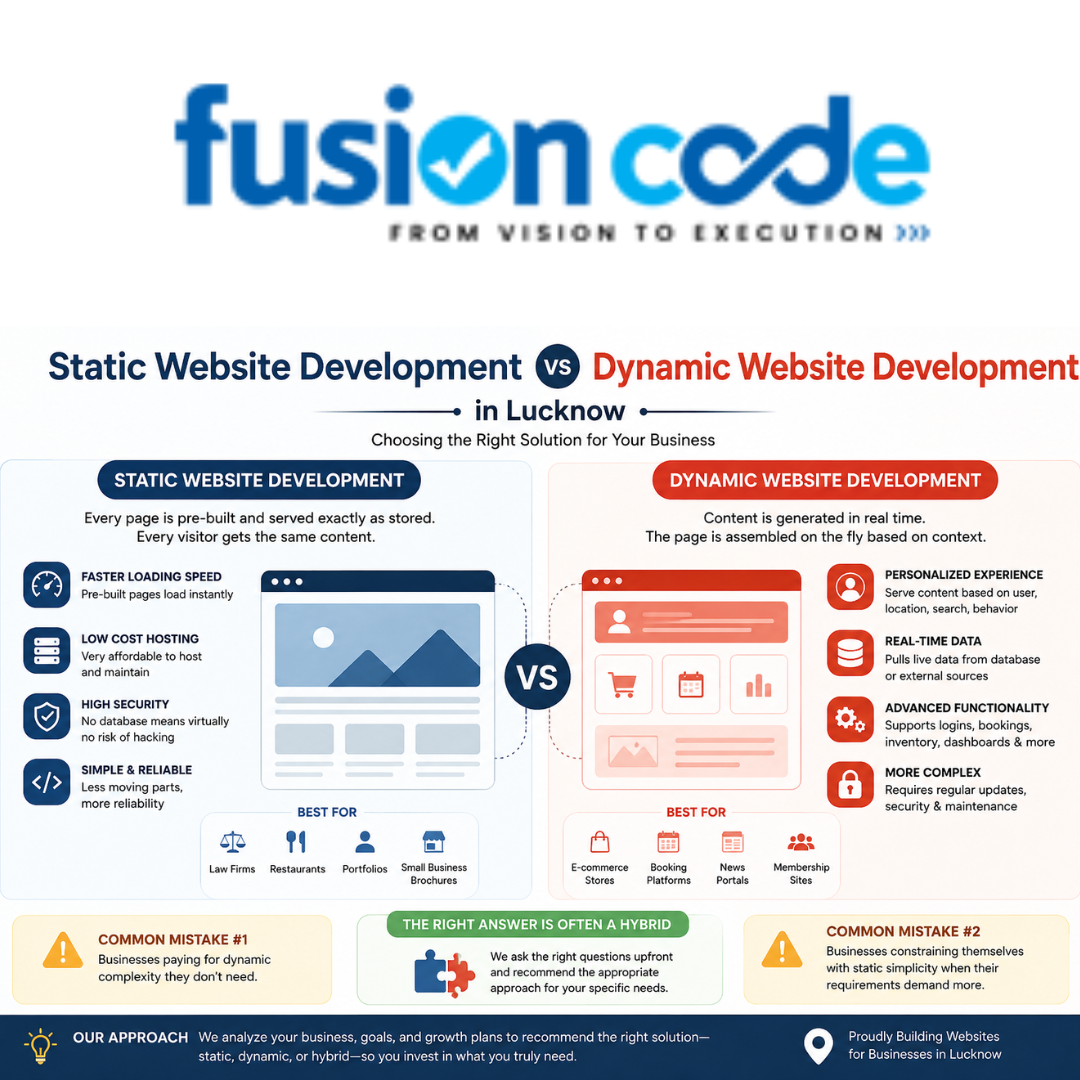
This question comes up in almost every initial conversation, and the answer is genuinely ‘it depends’.
Static website development in Lucknow means every page is pre-built and served exactly as stored. Every visitor gets the same content. There’s no server-side processing on each request.
This is actually the right choice for a lot of businesses. A lawyer’s website doesn’t need to serve different content to different visitors. A local restaurant’s site doesn’t need user accounts. A portfolio doesn’t need a database. Static sites load fast, cost very little to host, and are virtually impossible to hack in the conventional sense because there’s no database to compromise.
Dynamic website development in Lucknow generates content in real time. The page the server sends you is assembled on the fly based on who you are, what you’ve searched for, what’s in stock, or what the database says. You need this if your site involves user accounts, real-time inventory, personalised content, bookings, or anything where the content changes based on context.
The mistake we see most often is businesses paying for dynamic complexity they don’t need. The second most common mistake is businesses constraining themselves with static simplicity when their requirements clearly demand something more capable.
We ask the right questions upfront and recommend the appropriate approach. Sometimes the right answer is a hybrid.
Responsive Website Design in Lucknow: More Than Just Mobile-Friendly
Everyone says their website is mobile-friendly. Most of them mean it sort of works on a phone if you squint.
Responsive website design in Lucknow means the site genuinely adapts. Not just “the text gets smaller”. The layout reflows. Navigation transforms into something thumb-accessible. Images resize without distorting or overflowing their containers. Buttons are large enough to tap accurately. Forms can be filled out without zooming in. The call-to-action is prominent and accessible.
Why does this matter beyond just user experience?
More than 60% of web traffic now comes from mobile devices, according to Statcounter’s 2026 data. And because Google has used mobile-first indexing for years, it crawls and ranks your website based on the mobile version. A site that’s weak on mobile gets weaker rankings everywhere, including on desktop.
We test every site we build on real physical devices before launch. Not a browser window being dragged smaller. Actual phones and tablets across multiple browsers and across screen sizes from budget Android handsets to the latest iOS devices. If something breaks anywhere, we fix it before the site is live.
Google’s Mobile-Friendly Test will tell you in about thirty seconds where your current site stands on mobile.
UI/UX Design Company in Lucknow: Good Design Isn’t About Looks
There’s a version of web design that’s essentially interior decoration. Pick attractive colours. Add a hero image with a motivational subheading. Make the logo bigger.
And then there’s design that’s actually thinking about what a visitor is doing when they arrive on the site. Why are they here? What are they looking for? What would make them trust this business enough to take the next step? What’s getting in the way of that right now?
The second type is what a serious UI/UX design company in Lucknow should be doing. UI (User Interface) and UX (User Experience) are distinct disciplines that work together.
UI is the visual layer: the colours, fonts, icons, spacing, and overall aesthetic. Done well, it builds trust and communicates what kind of business this is within the first few seconds.
UX is the behavioural layer: information architecture, navigation logic, conversion path clarity, and friction reduction. Done well, visitors arrive on your site and know immediately where to look, what to do, and how to do it.
Bad UI loses trust. Bad UX loses customers. ‘Bad’ both means you’ve spent money on something that actively works against your business.
At FusionCodes, we wireframe before we design. We prototype before we develop. You click through your website before it’s built, which means feedback happens at the cheapest possible moment. After launch, changes are expensive. Before development, they’re just a conversation.
Nielsen Norman Group has forty years of user research behind its published work. They remain the most credible voice in UX research.
SEO-Friendly Website Development in Lucknow
A beautiful website that nobody can find on Google is just an expensive business card that nobody sees.
SEO-friendly website development in Lucknow is about building the technical foundation of a site in a way that search engines can read, understand, and rank correctly. This is different from the ongoing content and link-building work of SEO. It’s the structural layer underneath.
What does that look like at the code level?
Proper heading hierarchy. H1 tells Google what this page is primarily about. H2S and H3S organize the supporting content. Misuse this structure, and you’re sending confused signals to search engines.
Schema markup. Structured data embedded in your code enables rich results in Google search: FAQ answers, star ratings, business hours, product prices appearing directly in the results page before anyone clicks.
Clean URL structure. The difference between website.com/page?id=2847 and website.com/web-development-services-lucknow matters both for rankings and for user confidence.
Image optimisation. Every image should be compressed without visible quality loss, delivered in WebP format, and given alt text that describes what’s actually in the image.
HTTPS. An SSL certificate is both a confirmed Google ranking signal and a basic requirement for user trust in 2026. We configure this on every site.
Internal linking. Pages on your site linking to each other in ways that distribute authority logically and help search engines understand your content structure.
Page speed. Which gets its own section because it deserves one.
Google Search Console is free. It shows you exactly how Google sees your site and which pages have problems. Every business with a website should have this set up.
Why Website Speed Matters for SEO and Your Business
Nobody stares at a loading spinner in 2026.
The data on this is brutal. Google’s research shows 53% of mobile users leave if a page takes more than three seconds to load. Akamai found a single second of delay reduces conversions by 7%. And Google’s Core Web Vitals measure speed directly as a ranking factor, meaning slow sites rank lower across the board.
This is not an edge-case problem. Most business websites in Lucknow fail the Core Web Vitals assessment. Which means their competitors who pass it are ranking above them for exactly the same searches.
Here’s what we actually do about it:
Lazy loading means below-the-fold images don’t load until the user scrolls to them. The initial page load carries only what’s immediately visible, which is dramatically faster.
Code minification removes unnecessary characters from CSS and JavaScript files without changing what they do. Smaller files, faster loading.
A CDN (Content Delivery Network) distributes your website files across multiple locations. Someone visiting your site from Delhi gets the files from a server near Delhi. Someone in Lucknow gets them from closer. Both get faster load times.
Browser caching means returning visitors load your site almost instantly because their browser stores static assets locally from the first visit.
Proper hosting configuration. This sounds boring, but it matters enormously. Generic shared hosting settings are not optimised for anything in particular. We configure server environments specifically for how your website is built and how it will be used.
PageSpeed Insights gives you a free Core Web Vitals assessment for any URL. Run your current site through it right now and see where things stand.
Microservices Architecture for Websites: Do You Actually Need It?
Honest answer: probably not yet, if you’re a small or mid-size business. But if you’re building a SaaS product, a large e-commerce platform, or an enterprise application, you need to understand this before you commit to an architecture.
Traditional web applications are monolithic. Everything lives in one codebase: login, payments, emails, product catalogue, notifications, and user profiles. When you need to deploy an update to the notifications feature, you redeploy the whole application. When one thing breaks, it can affect everything else. When you need to scale because traffic spiked on your checkout page, you have to scale the whole application, which gets expensive.
Microservices break the application into independent services, each responsible for one function. The authentication service handles logins and nothing else. The payment service handles transactions. They communicate through APIs. You can update the notifications service without touching payments. A bug in the product catalogue doesn’t affect the checkout. You can scale just the parts that need it.
| What You Gain | What That Means Practically |
| Independent scaling | Pay to scale only what’s under load |
| Fault isolation | One broken service doesn’t crash the rest |
| Independent deployment | Ship features faster with less risk |
| Technology flexibility | Each service can use the right tool for its job |
| Easier maintenance | Smaller codebases are far less painful to work in |
FusionCodes designs microservices architecture for clients building products where uptime, scalability, and development velocity are serious business requirements.
Martin Fowler’s microservices article is the piece that set the industry definition. Long, technical, worth reading if you’re making real architecture decisions.
Web Development Process Step by Step at FusionCodes
We’ve heard the horror stories. Projects that dragged on for eight months. Final products that looked nothing like what was agreed. Agencies that went quiet after collecting payment. We built our process specifically around not being those people.
Step 1: Discovery Call
We start with a proper conversation, not a form. We want to understand your business goals, your customers, what your competitors are doing online, and what isn’t working right now. This conversation shapes every decision that follows.
Step 2: Clear Proposal
Everything discussed gets documented into a precise proposal: what we’re building, the technology we’ll use, a milestone-by-milestone timeline, and transparent pricing. You know exactly what you’re agreeing to before a single thing starts. No surprises down the road.
Step 3: Wireframing
Before any visual design begins, we map out the structure of every page. Where does navigation sit? What’s visible above the fold on the homepage? Where’s the call to action placed and why? Resolving these questions at the wireframe stage saves weeks of expensive revision later.
Step 4: Visual Design and Prototype
You get to click through a working prototype of your website before any developer touches it. You see how it flows, how it looks, how the mobile version behaves. Giving feedback here is easy and cheap. Asking for changes after development has started is neither.
Step 5: Frontend Development
Approved designs become real, working interfaces. Clean code. Fully responsive across every screen size. Fast to load. Accessible to all users. What you saw in the prototype is what you get in the browser, down to the pixel.
Step 6: Backend Development and Integrations
The server logic, database architecture, and API connections that make your website actually function. Built with security from the ground up, designed to handle real traffic, and structured to grow with your business rather than creak under the weight of it.
Step 7: Content Integration
Your text, images, and product data go into the website properly, not dumped raw and left for you to sort out. Every piece of content is formatted correctly, optimised for search engines, and placed exactly where it serves the visitor best.
Step 8: Testing
Every page. Every device. Every major browser. We run performance tests, security scans, form submissions, and link checks. If something breaks under real conditions, we find it here rather than your customers finding it after launch.
Step 9: Staged Review
You review the complete website on a staging environment before it touches your live domain. You click through everything, raise any final points, and give us your sign-off. Nothing goes live without your explicit approval.
Step 10: Go Live
Full deployment, DNS configuration, SSL setup, and active monitoring for the first 48 hours after your site goes live. We stay close at launch because that’s when unexpected things are most likely to surface, and we handle them before they become your problem.
Step 11: Ongoing Partnership
We don’t hand over a file and disappear. FusionCodes offers structured maintenance packages covering security updates, performance monitoring, content changes, and technical support. Your website is a living asset. We keep it that way.
Why FusionCodes is the Best Web Development Company in Lucknow
We’re not going to give you five bullet points with checkmark emojis. You’ve read that page on every agency website.
Here’s what actually differentiates us.
We’ve worked with businesses in Gomti Nagar, Hazratganj, Aliganj, Indira Nagar, and Vibhuti Khand long enough to understand the specific competitive realities of different industries in this city. We know what Lucknow’s audiences expect from a website in healthcare versus what they expect in logistics. That local context changes how we approach projects.
We don’t outsource. The developers, designers, and strategists you meet at the start are the people building your project. There is no handover to a cheaper subcontractor once the contract is signed.
We tell you what you actually need rather than what generates a bigger invoice. Not every business needs a complex web application. Not every startup needs an enterprise-grade infrastructure. We’re honest about this because clients who get the right thing for their situation become long-term relationships. Clients who get oversold don’t.
We design for what comes after launch, not just the launch itself. Technology choices, code architecture, and content management systems: all of it is selected with your team’s ability to maintain and grow the site in mind.
Most of our clients come back for more work. That’s the metric we care about more than any award or ranking.
Frequently Asked Questions: web development company in Lucknow
What does a web development company in Lucknow do?
Plans, designs, engineers, launches, and maintains websites and web applications. At FusionCodes, that means everything from the first strategy conversation through to post-launch maintenance, including custom design, frontend and backend development, e-commerce, API integrations, and the technical SEO foundation.
What services does a web development company offer?
Custom website development, e-commerce platforms, web applications, CMS-based sites, UI/UX design, responsive design, landing pages, website redesigns, API integrations, performance work, SEO-friendly development, and ongoing support. That’s the full list at FusionCodes.
What is custom web development, and why does it matter?
Building your website from scratch instead of modifying a template. It matters because templates impose constraints on performance, design, security, and features that often don’t match what your specific business needs. Custom development means the website is engineered for your audience and goals rather than adapted from something built for nobody in particular.
What is a responsive website, and why is it important?
A site that adapts its layout to display correctly on any screen, from a large monitor to a small phone. Critical in 2026 because the majority of web traffic is mobile, and Google ranks websites based on their mobile version. A site that breaks on phones loses visitors and loses rankings at the same time.
How do I get a professional website made in Lucknow?
Get in touch with FusionCodes for a free consultation. We talk through what you actually need, give you a clear proposal with honest pricing and timelines, and handle the whole project from there.
Why does website speed matter for SEO and business?
Google uses Core Web Vitals (which measure speed) as a ranking factor. Separately, slow sites have dramatically higher bounce rates and lower conversion rates. A slow site ranks lower and converts the smaller audience it attracts at a worse rate. Both effects cost real money.
How long does building a website take?
A standard business site is typically three to five weeks. E-commerce with a full product catalogue and payment integration runs six to ten weeks. Custom web applications vary. Every project starts with a scoping phase that produces a realistic milestone timeline.
How much does web development cost at FusionCodes?
Depends entirely on what you’re building. We give transparent quotes with no hidden fees. Reach out, and we’ll give you an honest estimate based on your actual project.
Will my site rank on Google?
Every site we build includes the technical SEO Foundation: proper code structure, schema markup, speed optimisation, mobile responsiveness, sitemap, clean URLs, and HTTPS. That gives your site the best possible starting point. For competitive keyword rankings over time, we offer dedicated SEO services built on top of that foundation.
Do you do maintenance after launch?
Yes. We offer structured maintenance packages covering security updates, performance monitoring, content changes, bug fixes, and technical support. A website needs ongoing care, and we’re available to provide it.
Final Word: web development company in Lucknow
If you’ve read this far, you’re either seriously considering building or improving a website for your business in Lucknow or you’re someone in the web industry who wanted to see how we write. Either way, welcome.
The businesses in Lucknow that invest properly in their digital presence in 2026 are pulling ahead. Not dramatically, not overnight, but steadily. Good rankings compound. A site that loads fast and converts well produces the reviews and referrals that make future marketing easier. The gap between businesses with strong websites and those without is wider now than it was three years ago, and it will be wider still three years from now.web development company in Lucknow.
If your website isn’t doing what it should be doing, that’s a fixable problem. It requires the right people working with the right brief toward a clear goal.
That’s what we do at FusionCodes. Come and have a conversation.