India processes more UPI transactions in a single month than most countries process in a year. As of early 2026, NPCI reported over 18 billion UPI transactions monthly. And a growing share of the companies building on top of this infrastructure are not from Mumbai or Bangalore. They are from Lucknow, Kanpur, Varanasi, and smaller cities across Uttar Pradesh.
The reason is simple. UP has one of the largest unbanked and underbanked populations in the country. Cooperative banks, microfinance institutions, small NBFCs, and payment startups serving this market need fintech software that works for their specific context, meets RBI’s requirements, and does not cost what a Bangalore firm would charge.
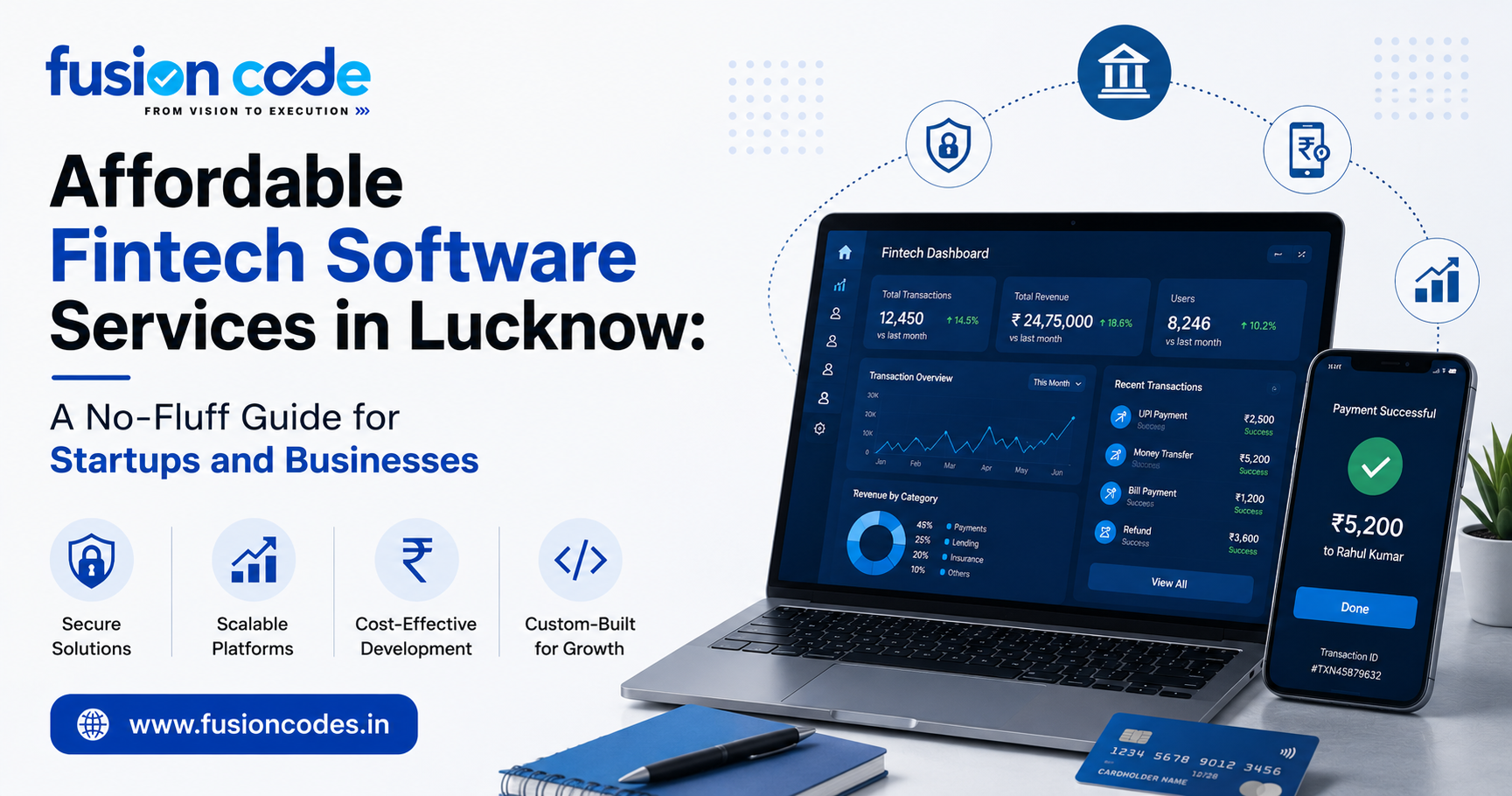
That is exactly what Fusion Codes does as an affordable fintech software service in Lucknow.
What Does a Fintech Software Company in Lucknow Actually Do?
This question comes up constantly, so let us answer it properly.
Fintech software is not regular business software with a payment button added. It involves real-time transaction processing, bank-grade encryption, regulatory compliance across multiple RBI and SEBI frameworks, and integrations with India’s financial infrastructure, including UPI, NACH, IMPS, credit bureaus, and Aadhaar-based KYC systems.
A proper affordable fintech software service in Lucknow handles all of this, not just the frontend that users see.
At Fusion Codes, fintech software services cover:
Payment Systems and Gateway Integration: Building custom payment flows and integrating gateways like Razorpay, PayU, Cashfree, and CCAvenue. This includes UPI-based checkout, QR payment infrastructure, merchant onboarding, and settlement reconciliation.
Digital Lending Platforms: Full loan origination and management systems covering borrower onboarding, credit assessment, eKYC, legal documentation, disbursement, EMI collection via NACH and UPI AutoPay, and collections workflows. Built in line with RBI’s digital lending guidelines.
Mobile Banking Applications: Mobile banking apps for cooperative banks, urban cooperative credit societies, and small finance banks. Account management, fund transfers, statement generation, and customer support are built for the feature phones and mid-range Android devices that dominate UP’s market.
Microfinance Software: Custom microfinance software in Lucknow for MFIs managing group lending, joint liability groups, field agent collection workflows, and portfolio-at-risk reporting as an affordable fintech software service in Lucknow.
Accounting and Payroll Software: Custom accounting software in Lucknow for businesses that have outgrown Tally and payroll management software covering attendance integration, CTC structuring, TDS computation, and payslip generation with GST compliance affordable fintech software service in Lucknow.
Digital Wallets: Closed-loop and semi-closed wallet systems built under RBI’s Prepaid Payment Instrument framework, with KYC tier management, UPI interoperability, and full transaction audit logging.
Why Is Custom Fintech Software Better Than Readymade Software?
Readymade fintech tools work fine when your requirements fit neatly inside what the vendor built. The problem is that they rarely do.
Take a cooperative bank in Lucknow serving farmers and small traders. Their loan products have seasonal repayment structures tied to crop cycles. Their KYC process involves physical verification in villages. Their collections happen in cash through field agents. No readymade lending software handles this out of the box. The bank ends up maintaining parallel spreadsheets to cover what the software cannot do, which defeats the purpose entirely.
Custom fintech software is built around how your business actually operates, not how a software vendor imagined a generic financial business might operate.
| Factor | Readymade Fintech Software | Custom Fintech Software |
| Upfront Cost | Lower | Higher |
| Recurring License | High, ongoing | None after build |
| Compliance Fit | Generic, needs workarounds | Built to your specific requirements |
| Scalability | Vendor’s ceiling | Designed for your growth plan |
| Integration Flexibility | Pre-defined connectors only | Integrates with any banking API |
| Code Ownership | Vendor owns it | You own it completely |
| Data Control | Vendor’s servers | You decide where data lives |
| Competitive Advantage | Same tool competitors use | Exclusive to your business |
The tipping point for most businesses is when manual workarounds around a readymade tool start consuming more staff time than the software saves. That is when custom stops being expensive and starts being necessary.
How to Develop a UPI Payment App in India
Building a UPI application is more layered than most people expect. Here is how it actually works.
First, understand your licensing position.
Direct UPI integration requires NPCI membership, which is available only to licensed banks and payment system providers. Most fintech startups are not NPCI members. The practical route is integrating through a licensed UPI PSP, Razorpay, PayU, or Cashfree, which holds the NPCI connection and exposes it to you via API. Your app talks to their API. Their system talks to NPCI.
Depending on what your app does with payments, you may also need a payment aggregator licence from the RBI if you are collecting money on behalf of multiple merchants and settling it to them. This is a 6- to 12-month process and needs to be determined before development begins because it changes the architecture significantly for affordable fintech software services in Lucknow.
Second, build the backend properly.
A UPI payment app needs the following:
- A real-time transaction processing engine that handles concurrent requests without race conditions
- A reconciliation system that matches every payment event against your internal ledger
- Webhook infrastructure to receive async payment status updates from the PSP
- A dispute management module for failed transactions and chargebacks
- An immutable audit log for every transaction event is required for regulatory inspection
Third, implement KYC and AML from the start.
Every UPI application in India must have KYC verification for users above the minimum transaction thresholds. This typically involves Aadhaar-based eKYC via UIDAI’s API (requires a sub-KSA arrangement with a licensed KSA), PAN verification via NSDL or a third-party provider like Karza or IDfy, and transaction monitoring for AML compliance.
Fourth, go through NPCI certification.
Before a UPI app goes live, it must pass NPCI’s mandatory certification covering functional testing, security auditing, and performance benchmarking. Your PSP partner will guide this process, but your technical team needs to prepare the application accordingly.
Fusion Codes has managed payment gateway integrations and UPI-based payment flows for clients across retail, lending, and insurance and handles the full technical implementation from architecture through certification support.
How to Integrate Razorpay in Custom Software
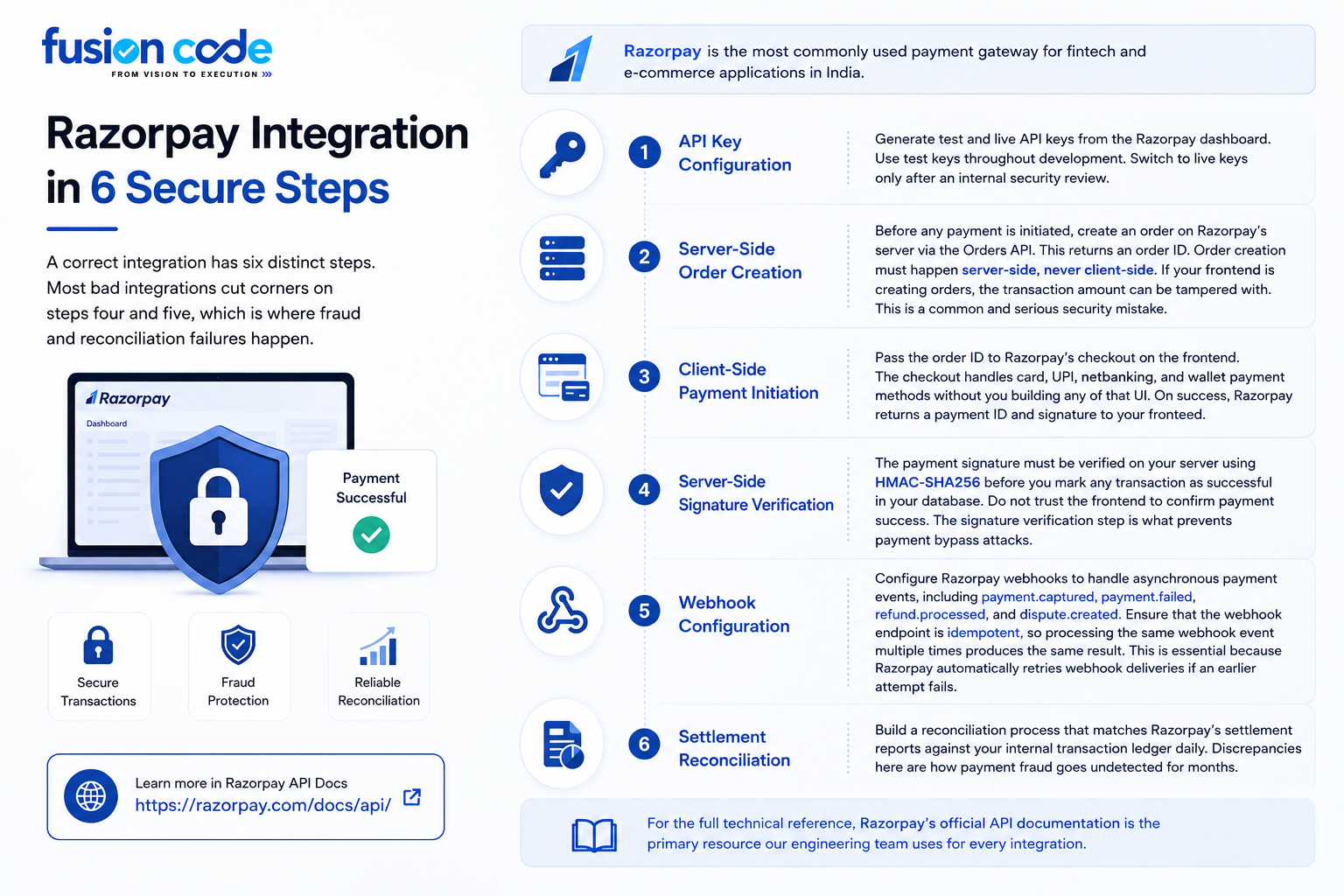
Razorpay is the most commonly used payment gateway for fintech and e-commerce applications in India. A correct integration has six distinct steps. Most bad integrations cut corners on steps four and five, which is where fraud and reconciliation failures happen.
Step 1: API Key Configuration: Generate test and live API keys from the Razorpay dashboard. Use test keys throughout development. Switch to live keys only after an internal security review.
Step 2: Server-Side Order Creation: Before any payment is initiated, create an order on Razorpay’s server via the Orders API. This returns an order ID. Order creation must happen server-side, never client-side. If your frontend is creating orders, the transaction amount can be tampered with. This is a common and serious security mistake.
Step 3: Client-Side Payment Initiation: Pass the order ID to Razorpay’s checkout on the frontend. The checkout handles card, UPI, netbanking, and wallet payment methods without you building any of that UI. On success, Razorpay returns a payment ID and signature to your frontend.
Step 4: Server-Side Signature Verification: The payment signature must be verified on your server using HMAC-SHA256 before you mark any transaction as successful in your database. Do not trust the frontend to confirm payment success. The signature verification step is what prevents payment bypass attacks.
Step 5: Webhook Configuration: Configure Razorpay webhooks to handle asynchronous payment events, including payment. captured, payment.failed, refund.processed, and dispute. created. Ensure that the webhook endpoint is idempotent, so processing the same webhook event multiple times produces the same result. This is essential because Razorpay automatically retries webhook deliveries if an earlier attempt fails.
Step 6: Settlement Reconciliation: Build a reconciliation process that matches Razorpay’s settlement reports against your internal transaction ledger daily. Discrepancies here are how payment fraud goes undetected for months.
For the full technical reference, Razorpay’s official API documentation is the primary resource our engineering team uses for every integration.
How to Build a Digital Lending Platform in India
A digital lending platform done properly is one of the more complex fintech products to build. RBI’s digital lending guidelines define strict requirements around loan servicing flows, data collection consent, communication channels, and how funds must move between lender, lending service provider, and borrower.
Here are the core modules:
Borrower Onboarding: Mobile-first application with Aadhaar eKYC or video KYC for fully digital onboarding, PAN verification, credit bureau pull from CIBIL or Experian, and bank account verification via penny drop or NACH mandate registration.
Credit Assessment Engine: Rule-based scoring for standard credit parameters and, for lenders targeting thin-file borrowers, alternative data scoring using GST filing patterns, transaction history, or telco data. The system must support both automated decisioning and manual review workflows for edge cases.
Loan Origination System: Application tracking, document verification, legal agreement generation with Aadhaar eSign or DSC-based signing, and disbursement trigger to the borrower’s bank account or wallet. Under RBI’s current guidelines, funds must flow directly from lender to borrower, not through an intermediary.
Loan Management System: Repayment schedule generation, NACH and UPI AutoPay mandate management for EMI collection, prepayment and foreclosure handling, and a customer-facing repayment portal.
Collections Module: Automated payment reminders via SMS, WhatsApp, and push notifications within RBI’s permitted communication windows, a field collection agent app for in-person recovery, and legal notice generation for NPA accounts.
Regulatory Reporting: RBI returns, credit bureau reporting for NBFC members, and a complete audit trail for every loan lifecycle event.
Fusion Codes works with compliance consultants during lending platform builds to ensure the technical architecture meets regulatory requirements from the first sprint, not as a retrofit at launch.
KYC and AML Compliance in Fintech Software Development
KYC and AML are not features. They are regulatory obligations with legal consequences for non-compliance. Here is what proper implementation looks like.
KYC Implementation
- Aadhaar-based eKYC via UIDAI API requires either a direct UIDAI licence or a sub-KSA arrangement with a licensed entity
- Video KYC (V-CIP) for accounts requiring full KYC without a physical branch visit
- PAN verification via Income Tax APIs or providers like Karza, IDfy, or Signzy
- Liveness detection to prevent spoofing during selfie or video verification
- Document OCR to extract data from identity documents and cross-verify against user input
AML Implementation
- Rule-based transaction monitoring: alerts for unusual amounts, frequencies, or geographies
- Sanctions screening against UN, OFAC, and MHA watchlists in real time
- PEP (Politically Exposed Person) screening during onboarding and periodically after
- STR (Suspicious Transaction Report) generation workflow for filing to FIU-IND
- Customer risk categorization into low, medium, and high tiers based on transaction behavior and business type
Where transaction volumes are high enough, Fusion Codes implements affordable fintech software service in Lucknow ML-based anomaly detection alongside rule-based systems. Static rules catch known fraud patterns. Machine learning catches new ones that the rules have not seen yet.
AI Fraud Detection in Fintech Platforms
Rule-based fraud systems work until they don’t. Fraudsters study the rules and route around them. Machine learning models are harder to game because they do not operate on fixed thresholds. They learn what normal looks like for each user and flag what deviates from it.
How AI Fraud Detection Works in Practice
Behavioural anomaly models build a baseline for each user: typical transaction size, time of day, merchant category, device fingerprint, and location. A transaction that falls outside this baseline gets flagged, not because it breaks a rule, but because it does not match the user’s history.
Graph-based models map connections between accounts, devices, phone numbers, and IP addresses. A single account looks clean. But when it is connected to 40 other accounts that all registered from the same device cluster, the graph reveals a fraud ring that individual transaction analysis would miss entirely.
Real-time scoring runs before every transaction is approved, typically within 50 to 100 milliseconds. Transactions above a risk threshold trigger step-up authentication or a block. Below the threshold, the transaction proceeds without friction.
The models need retraining on fresh data regularly. Fraud patterns evolve faster than annual model review cycles. A fraud detection system that has not been updated in 18 months is a gap, not a control.
Fusion Codes integrates both custom ML fraud models for clients with sufficient transaction history and third-party fraud APIs like Razorpay Shield or Sift for earlier-stage platforms. For a technical overview of how ML is applied in financial fraud detection at scale, Google Cloud’s Financial Services AI documentation covers the architecture patterns used in production fraud systems and affordable fintech software service in Lucknow.
How Does a Digital Wallet Work Technically?
A digital wallet stores monetary value in a software ledger and facilitates transactions without physical cards. In India, wallets operate under the RBI’s Prepaid Payment Instrument framework. Here is the technical structure.
The Ledger: Every wallet is built on a double-entry ledger. Every debit on one account is matched by a credit on another. The wallet balance is derived from the sum of all ledger entries, never stored as a separate field. This prevents balance manipulation. The ledger must be ACID-compliant: every transaction either completes fully or does not happen at all. Partial writes are the most dangerous failure mode in financial software.
Fund Loading: Users load funds via UPI, debit card, or netbanking. Each load event creates a credit entry in the ledger and a corresponding record in the payment gateway reconciliation system.
Transaction Processing Flow
- Verify available balance
- Lock the transaction amount to prevent double-spend under concurrent requests
- Debit sender ledger
- Credit recipient ledger
- Write an immutable transaction record
- Release lock
- Send confirmation to both parties
KYC Tiers Under RBI’s PPI Framework Minimum KYC wallets: balance limit of Rs. 10,000, usable only for purchases. Full KYC wallets: balance limit of Rs. 200,000, support fund transfers, and full UPI interoperability. The software must enforce these limits programmatically and escalate users through KYC tiers as verification is completed.
Interoperability: Since the RBI mandated full PPI interoperability, wallet balances can be transferred to any UPI-linked account. This requires UPI integration via a PSP arrangement with a licensed bank or payment system provider affordable fintech software service in Lucknow.
India Fintech Market Growth and What It Means for UP Businesses
Some context worth having before you decide whether to invest in custom fintech software.
India’s fintech adoption rate sits at 87% against a global average of 64%, according to EY’s Global Fintech Adoption Index. The MSME credit gap stands at an estimated Rs. 20 to 25 lakh crore. Rural and semi-urban UP represents a significant share of both the underserved borrower population and the informal economy that digital payment infrastructure is beginning to reach.
For cooperative banks, MFIs, and affordable fintech software service in Lucknow, the market opportunity is concrete. The infrastructure to serve it – UPI rails, Aadhaar KYC, the account aggregator framework, OCEN for lending – is largely in place. What most local financial institutions lack is the software to use it.
This is where an affordable fintech software service in Lucknow from a company that understands both the technology and the local market context becomes genuinely valuable.
Cost Estimates for Common Fintech Products at Fusion Codes
| Product | Estimated Cost | Timeline |
| Payment Gateway Integration (Razorpay or PayU) | Rs. 1.5 to 3 Lakhs | 3 to 5 Weeks |
| UPI Payment App (Basic) | Rs. 8 to 15 Lakhs | 12 to 18 Weeks |
| Microfinance Software | Rs. 6 to 12 Lakhs | 10 to 16 Weeks |
| Digital Lending Platform (MVP) | Rs. 15 to 30 Lakhs | 16 to 24 Weeks |
| Mobile Banking App | Rs. 12 to 22 Lakhs | 14 to 20 Weeks |
| Accounting Software (Custom) | Rs. 4 to 8 Lakhs | 8 to 14 Weeks |
| Payroll Management Software | Rs. 3 to 6 Lakhs | 6 to 10 Weeks |
| Digital Wallet (PPI-Compliant) | Rs. 20 to 35 Lakhs | 20 to 28 Weeks |
These figures assume a well-defined scope. Regulatory complexity, third-party integration requirements, and licensing dependencies affect both cost and timeline. Every Fusion Codes engagement includes a scoping session before a final proposal is issued for affordable fintech software service in Lucknow.
Fintech Software Development Lifecycle at Fusion Codes
Fintech development differs from standard affordable fintech software services in Lucknow builds because compliance and security are not final checkboxes. They run through every phase.
Phase 1: Regulatory Discovery: Before any technical work, we map which RBI, SEBI, or FIU-IND requirements apply to your product. Skipping this step is how teams build products that need full architecture rework before they can legally launch.
Phase 2: System Architecture: Financial software needs specific patterns: event sourcing for immutable audit logs, CQRS for read/write separation at scale, encryption at rest and in transit, and reconciliation design that handles settlement discrepancies cleanly.
Phase 3: Security Design: Threat modelling, encryption key management, API authentication strategy (OAuth 2.0, mTLS for core banking APIs), and penetration testing scope. Security is designed in, not bolted on.
Phase 4: UI/UX Design: Financial UX balances simplicity for end users with compliance disclosures, transaction confirmation flows, and error states that actually tell users what happened. Every design is responsive from the first wireframe.
Phase 5: Sprint-Based Development: Two-week sprints with working demos at each cycle. Compliance-critical flows are built and reviewed first.
Phase 6: Security Testing: Internal security review followed by third-party VAPT before production deployment.
Phase 7: Deployment and Monitoring: Real-time transaction monitoring, anomaly alerting, and a defined incident response procedure from day one.
Phase 8: Ongoing Support: Regulatory requirements change. Payment network rules get updated. Tax calculations shift. Post-launch support for fintech is ongoing compliance management, not optional maintenance.
Frequently Asked Questions: affordable fintech software service in Lucknow
What does a fintech software company in Lucknow do?
A fintech software company builds digital financial products and infrastructure. This includes payment systems, lending platforms, mobile banking apps, wallets, accounting tools, KYC systems, and compliance infrastructure. At Fusion Codes, every product is built with RBI compliance requirements, bank-grade security architecture, and integrations with India’s financial rails, including UPI, NACH, and credit bureau systems.
How long does it take to build a fintech app in India?
It depends heavily on what you are building. A basic payment gateway integration takes 3 to 5 weeks. A UPI payment app takes 12 to 18 weeks. A full digital lending platform takes 16 to 24 weeks at a minimum, and longer if licensing and compliance setup are not already in place before development begins.
Is custom fintech software RBI-compliant?
Custom software can be built to any regulatory specification, which is its advantage over ready-made tools. RBI compliance is not a binary state. Different products fall under different frameworks: PPI guidelines for wallets, digital lending guidelines for lending apps, and payment aggregator regulations for multi-merchant payment collection. Fusion Codes maps the applicable regulations during discovery and designs the architecture around them from the start.
What is the difference between a payment gateway and a payment aggregator?
A payment gateway is the technology layer that routes transactions between a merchant, the customer’s bank, and the acquiring bank. A payment aggregator is a licensed entity under the RBI that collects payments on behalf of multiple merchants and settles funds to them. If you are building a platform where multiple merchants accept payments through your system, you need a PA licence. If you are building a single-merchant checkout, gateway integration alone is sufficient.
Can Fusion Codes build microfinance software for an MFI in Uttar Pradesh?
Yes. We have built microfinance software for MFIs and cooperative lenders operating in UP. The software covers group lending management, JLG tracking, field agent collection apps with offline sync capability for low-connectivity areas, portfolio-at-risk dashboards, and credit bureau reporting for NBFC-MFIs and makes your affordable fintech software service in Lucknow.
Three Things Worth Remembering: affordable fintech software service in Lucknow
Custom fintech software in India is not just a technical build. Every product touches regulated territory, and the architecture decisions made in week two affect your compliance posture years later.
The businesses that navigate this well share three traits. They understand the regulatory requirements that apply to their specific product before development starts. They choose development partners who have built fintech products before, not just software in general. And they treat post-launch compliance management as an ongoing responsibility, not something that ends at go-live.
Fusion Codes is an affordable fintech software development company in Lucknow building payment systems, lending platforms, and banking applications for startups and institutions across Uttar Pradesh and beyond.
Contact Fusion Codes to discuss your fintech project and get a scoped proposal.
[Talk to Our Fintech Team →] [email protected]