

APAAR ID work has landed on almost every school office in India this year. Education departments want faster progress, parents have questions about consent, and staff are matching Aadhaar spellings against admission registers one student at a time.
Most of this work is not hard. It is repetitive. The same student details get typed into UDISE+, the school register, the board registration form, and the parent contact list, and every copy is a fresh chance for a mismatch.
This guide explains what APAAR and UDISE+ ask of schools in 2026-27, what the July 2026 Supreme Court order changed about consent, and how APAAR ID school software cuts the admin time without cutting corners on student privacy.
What Is APAAR ID and How Does It Connect to UDISE+?
APAAR stands for Automated Permanent Academic Account Registry. It is a scheme under the National Education Policy 2020 that gives a student a lifelong, Aadhaar-linked academic ID number, so their records can follow them across schools and states.
Here is how the pieces fit together for a school:
- UDISE+ is the national school data portal. Schools enter student details here, and APAAR IDs are generated from this verified data.
- APAAR ID is a 12-digit number for each student whose parents have consented. It can carry marks, certificates and achievements over time.
- DigiLocker is where the APAAR ID is linked, so students and parents can access academic records digitally.
- Academic Bank of Credits uses APAAR later in higher education to track and transfer credits between institutions.
The scale is already large. According to a CIET-NCERT letter dated 22 July 2026, more than 16.63 crore APAAR IDs had been generated and verified through UDISE+ by 21 July 2026.
What Changed for Schools in 2026-27
The push in 2026-27 is speed. In July 2026, CIET-NCERT asked states to reach full APAAR coverage quickly, and education departments passed that pressure down to school heads. For a school office, it shows up in four ways.
Progression comes first
The CIET-NCERT letter asks schools to finish all pending UDISE+ progression work before APAAR ID generation resumes. In simple terms, last year’s student records must be closed and moved forward correctly before new IDs can be created. A school with messy progression data gets stuck at the first step.
Consent drives through parent meetings
Schools are asked to hold parent-teacher meetings to explain APAAR and collect consent for students whose IDs are pending. That means printing forms, tracking who signed, who refused, and who has not responded, for every class.
Aadhaar mismatches need fixing
Students without Aadhaar, or whose Aadhaar details do not match school records, need enrolment or update camps. A single wrong letter in a name or a different date of birth can block an ID.
Board registrations depend on it
For CBSE schools, APAAR IDs are used for Class 9 and 11 registrations and Class 10 and 12 board exam lists from the 2026 session. Gaps in APAAR data now show up during registration season, when time is short.
In Delhi, for example, the Samagra Shiksha circular asks heads of schools to monitor progress personally and asks districts to submit weekly action-taken reports. Other states run similar drives, so check your own state’s latest circular.
Is APAAR ID Mandatory? What the Supreme Court Said
APAAR is officially a voluntary scheme, and parents can refuse consent. On 20 July 2026, the Supreme Court disposed of a petition by parents of CBSE students in Abhishek Baxi and Others v. Union of India. According to a plain-language summary of the order, the Court directed that:
- The consent form must offer a clear option to refuse. The model APAAR consent form is to be amended across India so parents can withhold consent.
- The DPDP Act applies to all APAAR data. Collection, storage, retention, sharing and use of student data must follow the Digital Personal Data Protection Act, 2023.
- No sharing with private parties except as the law permits and only for purposes authorised under the scheme.
The Court did not strike down APAAR. For schools, the practical message is simple: push for coverage, but keep consent real and keep records of it.
What this means for your school office
- Use the updated consent form that shows a clear decline option.
- Record every response as consented, refused, or pending, with the date.
- Do not make admission, exam registration, or a transfer certificate depend on APAAR consent without checking current board and state guidance.
- Treat APAAR and Aadhaar data as sensitive. Limit who can see it and keep a log of access.
This section is general information, not legal advice. Read your board’s and state’s latest circulars before changing your process.
Where School Offices Lose the Most Time
The delays rarely come from the portal itself. They come from the data a school brings to it. These are the problems that eat the most hours:
- The same data in five places. Admission forms, the class register, fee records, UDISE+, and board registration each hold their own copy of a student’s name and date of birth. They drift apart over the years.
- Name and date mismatches with Aadhaar. “Mohd.” in one record and “Mohammad” in another, or a birth date entered in the wrong format, is enough to stop an APAAR ID.
- Consent tracked on paper. Forms go home in bags; some come back, some get lost. Nobody can say quickly which students in Class 7B are still pending.
- Last year’s progression left open. Students who left, failed, or changed sections were never updated, so the new session cannot start cleanly.
- Chasing parents one call at a time. Reminders for missing documents and consent happen through individual calls and diary notes.
- No single progress view. When the district asks for a status report, someone builds it by hand from several spreadsheets.
How School Management Software Saves Admin Time on APAAR and UDISE+
APAAR IDs are generated only through UDISE+, so no school software can create them. What good software does is make the data you take to UDISE+ clean, complete, and easy to track. Here is how each problem maps to a fix:
| Problem in the office | What school software does |
|---|---|
| Same data stored in many places | One student master record used by admissions, fees, exams and reports |
| Aadhaar mismatches | Flags names, dates of birth, and gender that differ from Aadhaar details before submission |
| Consent tracked on paper | Digital consent tracker with consented, refused, and pending status for every student |
| Open progression records | Class-wise promotion, transfer and exit updates done in bulk at session end |
| Chasing parents by phone | Bulk reminders through the parent app, SMS, or WhatsApp for missing documents and consent |
| Status reports built by hand | Live dashboard showing APAAR coverage by class and section |
| Re-typing data into portals | Exports in the formats your UDISE+ coordinator and board registration need |
| Sensitive data on shared computers | Role-based access, so only authorised staff see Aadhaar and APAAR fields, with an access log |
Store the APAAR ID once, use it everywhere
Once an ID is generated, it should sit in the student’s profile alongside the admission number. Report cards, transfer certificates and board registration lists can then pull it automatically instead of someone copying it from a printout.
Keep consent records you can show
With the Supreme Court’s direction on refusals of consent, a dated digital record of each parent’s choice protects the school. If a parent or inspector asks, you can show exactly what was offered and what was chosen.
Protect student data by design
APAAR data must be handled under the DPDP Act. Good software helps the school, as the data fiduciary, stay in control: encrypted storage, limited access by role, no sharing with outside parties, and the ability to correct or delete records when required.
For a full overview of school software modules and pricing, read our School Management System Software guide.
A Step-by-Step APAAR Data Process for School Offices
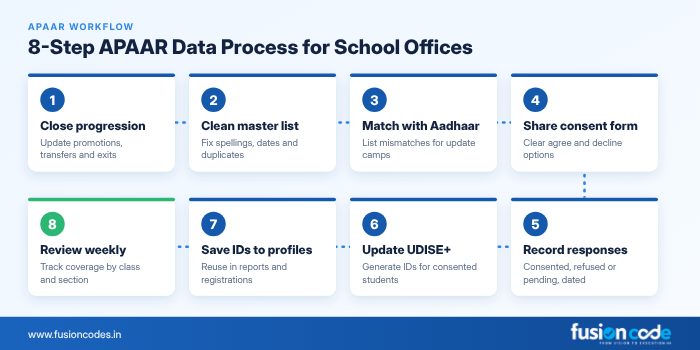
This process works whether you use software or not, but software makes each step faster. Follow it in order:
- Close last year’s progression. Update promotions, transfers, exits, and section changes so the student list matches who is actually enrolled.
- Clean the student master list. Fix spellings, dates of birth, and parent names in one place, and remove duplicate records.
- Match records with Aadhaar. Compare each student’s details with their Aadhaar. List students without Aadhaar or with mismatches for the next enrolment or update camp.
- Share the consent form. Send the updated form with a clear decline option through a parent meeting, the parent app or a printed copy.
- Record every response. Mark each student as consented, refused, or pending, with the date. Follow up with pending parents in batches.
- Update UDISE+ through your coordinator. Submit details for students with consent and generate APAAR IDs on the portal.
- Save the IDs back to student profiles. Add each generated APAAR ID to the school’s records so reports and registrations can use it.
- Review progress every week. Check coverage by class, clear blockers, and share the status with your district if asked.
What to Look for in School Software for APAAR Work
Before you buy or upgrade, ask the vendor these questions:
- Can it store the APAAR ID and consent status in each student’s profile?
- Does it flag Aadhaar mismatches before data goes to UDISE+?
- Can it export student data in the formats your UDISE+ coordinator and board need?
- Can parents receive consent requests and reminders on their phones?
- Who can see Aadhaar and APAAR fields, and is every access logged?
- Where is the data stored, and does the vendor commit to never sharing it with third parties?
- Can promotions and transfers be updated for a whole class at once?
How FusionCodes Helps Schools
FusionCodes builds school management software for schools across Uttar Pradesh and India from our office in Gomti Nagar, Lucknow. We develop the system around your school’s board, size, and processes, rather than asking you to fit a fixed product.
For APAAR and UDISE+ work, we can add a single student master record, Aadhaar mismatch checks, a digital consent tracker, bulk progression tools, parent reminders, and class-wise coverage dashboards to your system.
As an ISO 27001:2022 certified company, we build role-based access, encryption, and access logs into every system, so student data stays under the school’s control.
Frequently Asked Questions
What is the full form of APAAR?
APAAR stands for Automated Permanent Academic Account Registry. It is a lifelong academic ID for students under the National Education Policy 2020.
Is APAAR ID mandatory for students?
The scheme is officially voluntary. In July 2026, the Supreme Court directed that the consent form must give parents a clear option to refuse, and that all APAAR data be handled under the DPDP Act, 2023.
Can school management software generate APAAR IDs?
No. APAAR IDs are generated only through the UDISE+ portal. School software helps by keeping student data accurate, tracking consent, and storing the ID once it is created.
Why is an APAAR ID not getting generated?
The most common reasons are pending UDISE+ progression, missing parental consent, and a mismatch between school records and Aadhaar details such as name spelling or date of birth.
Do CBSE schools need APAAR IDs for board registration?
CBSE uses APAAR IDs for Class 9 and 11 registrations and Class 10 and 12 board exam lists from the 2026 session. Check the latest CBSE circular for how to handle students whose parents have refused consent.
Is it safe to store APAAR and Aadhaar data in school software?
It can be, if the software uses encryption, role-based access, and access logs, and the vendor does not share data with third parties. The school remains responsible for the data under the DPDP Act.
Conclusion: Clean Data Makes APAAR Work Easy
APAAR and UDISE+ are not going away, and each new session will bring the same tasks. Schools that keep one clean student record, track consent properly, and protect data by design spend far less time on every drive.
The right school software turns weeks of register-checking into a few hours of review, and gives you a clear answer whenever the district asks for an update.
Want APAAR and UDISE+ tools in your school software? Talk to the FusionCodes team for a free demo, or call 0522-4609457.