AI in Entertainment Industry: it’s already changing what you watch, hear, and play. Open Netflix or JioHotstar tonight and look closely at the poster in the first row. That image was very likely selected by an algorithm, which compared your recent viewing with the habits of millions of other subscribers.
But the thumbnail is the easy part to spot. What you don’t see is the work that happened months earlier. Trailer editors now get a rough first cut from software, sometimes overnight. That wobbly handheld shot from the chase scene? Fixed in post, usually without anyone on set ever knowing. Dubbing tends to start life as a machine translation that a human then cleans up line by line. And some directors now hand their composer an AI-made sketch that basically says, “this is the mood I want.”
For people who make films, songs or games, the debate has moved on. Nobody serious is asking whether to touch AI anymore; they’re asking which jobs it should do, and which ones it should stay well away from.
We work on AI products for media companies at Fusion Codes, so these questions land on our desk a lot. Everything below is real: things studios, labels and game makers have actually done, not predictions. We’ll start with Hollywood and Bollywood, then move on to music, games and the streaming apps on your phone.
What Is AI in Entertainment Industry?
In plain terms, it is software that has studied millions of examples, such as films, songs, scripts, or viewing records, and picked up the patterns in them. Studios and streaming services use that skill in different ways: to create something new, to fix footage, to find an audience, or to suggest what you might watch tonight. Broadly, the tools fall into two groups.
Predictive AI is the number-cruncher. Feed it viewing logs, ticket sales, and release dates, and it will tell you which show you’re likely to start next, or whether a Friday release is heading for a soft opening weekend.
Generative AI is the side most people have heard of, and also the side most people worry about. Type a description of a scene, a monster or a voice, and the software produces a rough version in seconds. Ad agencies sometimes use it to compare a few jingle ideas before they book a singer.
On streaming services, the two kinds of AI usually work together. The predictive kind guesses what a certain group of viewers will like, and the generative kind changes the poster, trailer or subtitles for those viewers.
AI in Entertainment Industry: Market Size, Trends and Statistics
Nobody can quite agree on how big this market is, which says a lot about how young it still is. What every report does agree on is that it’s growing quickly.
| Source | Forecast | Yearly growth |
|---|---|---|
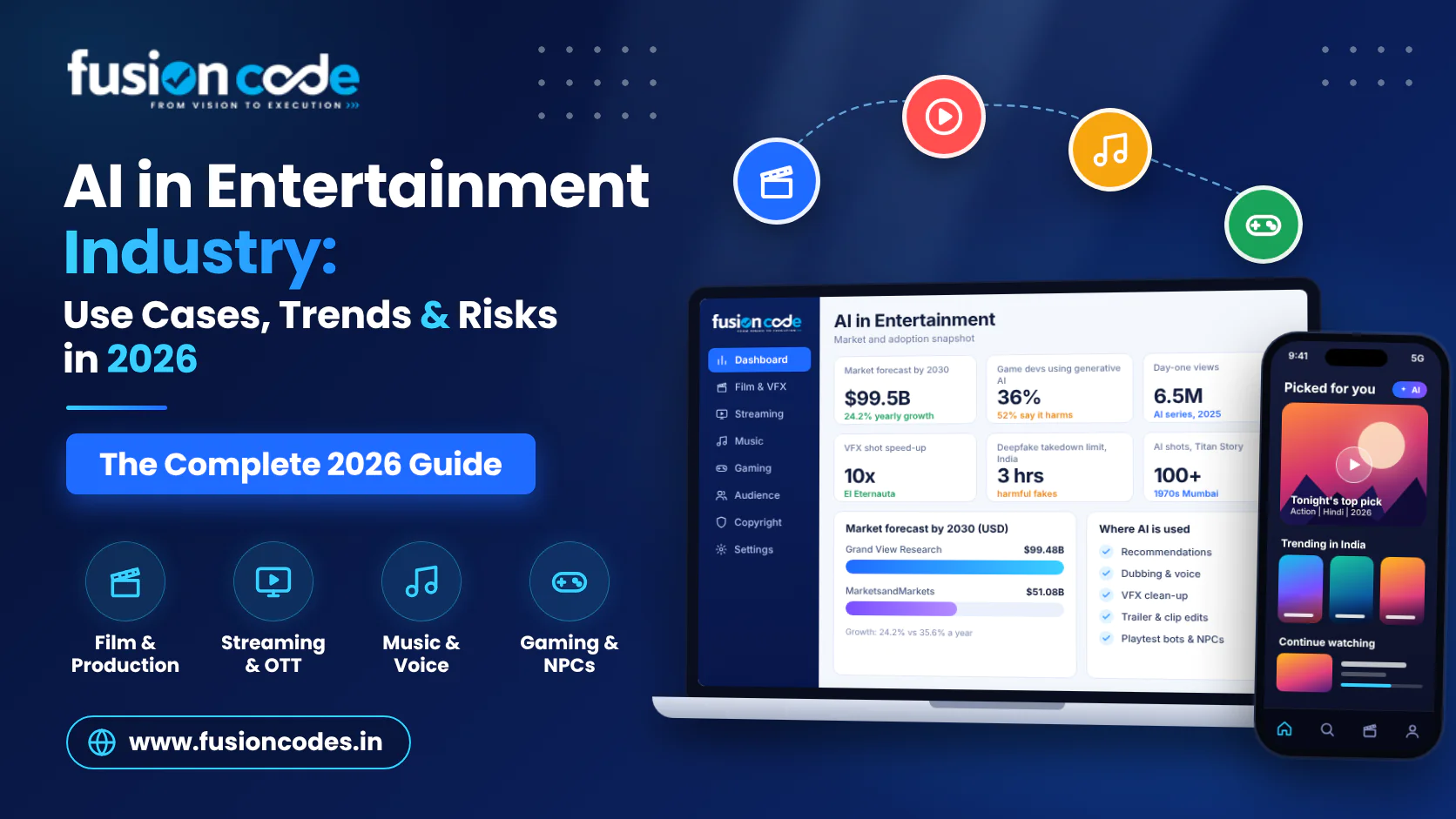
| Grand View Research | USD 99.48 billion by 2030 | 24.2% |
| MarketsandMarkets | USD 51.08 billion by 2030 | 35.6% |
Developments to watch in 2026:
- Personalised recommendations that now reach well beyond films and series into music playlists
- LED-wall virtual sets, which spare producers the cost of sending a crew abroad
- Faster dubbing, reducing a process of several weeks to a few days
- Rapid growth across Asia-Pacific, including India
- Detection software designed to catch deepfakes before they spread
AI in Entertainment Industry: Film and Movie Production
Cinema is where you can see AI at work most clearly, partly because budgets are big and partly because every day saved on a shoot is real money.
Before the shoot
On set and after
- Script-breakdown software can turn a screenplay into a draft shooting schedule, scene by scene, in about a day.
- Directors often sketch camera positions and lighting in rough digital storyboards before any illustrator is hired.
- A number of studios consult audience-forecasting models before committing money to a project.
Post-production is where AI does much of its quietest work. Removing safety wires, matching colour between two cameras, restoring damaged archive footage and filling empty seats in a stadium are all tasks it now handles. Audiences rarely notice, yet the time saved for editors is considerable.
The example everyone in the industry quotes is El Eternauta, a Netflix series made in Argentina. Its team used generative AI to show a building collapsing in Buenos Aires, and Netflix said the shot was done about ten times faster than with a normal VFX workflow (Business Insider). On a show of that size, the company admitted, the scene simply wouldn’t have fit the budget otherwise.
Voice cloning and dubbing
Imagine a Telugu action film opening in Madrid, and the hero still sounds like himself, only now he’s speaking Spanish. That’s already doable with today’s dubbing tools.
Where it gets tricky is consent. If the actor hasn’t agreed, or isn’t being paid, it crosses a line.
Hollywood vs Bollywood
Hollywood has strong unions, and they used the 2023 strikes to get AI protections written into their contracts. Studios there now check the fine print before trying anything new.
Bollywood has moved faster, and it has already had its first big fight. When Raanjhanaa came back to theatres in Tamil in 2025, the producers had used AI to give it a happy ending. Director Aanand L. Rai and actor Dhanush both said publicly that they weren’t on board (Variety).
AI in streaming platforms
Every subscriber leaves a trail. The platform notes when an episode is paused, when a series is dropped halfway, and when a scene is rewound. Those small signals shape the rows on the home screen and the order in which they appear.
As a result, no two accounts see an identical page. Two friends browsing the same series may even be shown entirely different poster artwork.
How does Netflix use AI?
- Home page: ranks rows and titles just for you
- Artwork: picks the thumbnail you’re most likely to click
- Search: helps you find shows faster
- Video quality: keeps the picture sharp on slow internet
- Production: creates visual effects, as in El Eternauta
Indian apps like JioHotstar, Prime Video and ZEE5 do the same, and also juggle Hindi, English and regional languages for one household.
AI in the music industry
The music business went from suing AI companies to signing deals with them.
The legal dispute did not last long. The major record labels took Suno and Udio to court in 2024, yet by the end of 2025 Universal and Warner had reached settlements and agreed to launch licensed AI music platforms in 2026 (Music Business Worldwide).
How is AI used in music production?
- Sketching melodies and demo tracks from a short prompt
- Pulling vocals, drums, and bass apart for remixes
- Mixing and mastering songs automatically
- Building playlists that match your mood
Best AI tools for music creation
| Tool | Good for |
|---|---|
| Suno | Full songs with vocals |
| Udio | Song ideas and remixes |
| Stable Audio | Loops and sound effects |
| LANDR | Quick mastering |
| AIVA | Film and game scores |
Before releasing any track made with these tools, check the licence carefully, as commercial rights differ from one service to another.
AI in the gaming industry
Game developers remain split on the subject. In the GDC 2026 State of the Game Industry survey, 36% of respondents said they use generative AI at work, but 52% felt it was damaging the industry (TechSpot).
How is AI used in video game development?
- Brainstorming and research (the top use)
- Writing and fixing code
- Building huge maps and levels automatically
- Bots that play-test games and find bugs
- Smoother, more lifelike character movement
Smarter NPCs
In most games, non-player characters follow a fixed script and repeat a small set of lines. AI-driven characters, by contrast, can answer whatever the player types or says, and some remember previous conversations.
The problem lies in keeping them under control. A character that improvises is difficult to test and may say something that undermines the plot, which is why most studios still restrict AI to the development stage.
AI in advertising and content marketing
Marketing departments are usually the first to see a return on their AI investment.
- Editing software scans the finished film and proposes shots for trailers and 15-second social clips.
- A key poster can be reworked into hundreds of regional versions, such as one with Hindi text for Delhi and another in Tamil for Chennai.
- Advertising spend is moved during the day towards the viewers who are engaging most.
- Social-listening tools reveal, within a few hours of release, how audiences have received a teaser.
AI tools for filmmakers and video creators
| Need | Tools to try |
|---|---|
| Generate shots | Runway, Google Veo, Sora |
| Edit faster | Premiere Pro, DaVinci Resolve, Descript |
| Dub and voice | ElevenLabs, HeyGen |
| Restore footage | Topaz Video AI |
| Make short clips | Opus Clip, CapCut |
AI in the Indian entertainment industry
India has become one of the busiest markets for AI-made entertainment. A large audience spread across many languages, together with tight budgets, gives producers a strong reason to experiment.
A few recent projects stand out:
- Mahabharat: Ek Dharmayudh (JioHotstar, 2025): a series produced entirely with AI, which recorded about 6.5 million views on its first day (Indian Television).
- JioStar’s next slate: further AI series, a feature film about Hanuman, and short dramas for mobile viewers are in development.
- Chiranjeevi Hanuman – The Eternal: promoted as India’s first AI-generated film for theatrical release (THR India).
- Made in India: The Titan Story: more than 100 AI-generated shots were used to recreate Mumbai as it looked in the 1970s (Vitrina).
Two advantages matter most to Indian producers. Large mythological dramas can be made at a lower cost, and a finished film can be dubbed into Tamil, Telugu, or Bengali within days.
Quick case studies: what we can learn
| Case | What happened | Lesson |
|---|---|---|
| Netflix, El Eternauta | AI VFX done 10x faster | AI lets smaller budgets dream bigger |
| JioStar, Mahabharat | Big day-one audience | Familiar stories help viewers accept AI |
| Warner and Suno | Lawsuit turned into a deal | Licensing beats fighting |
| Eros, Raanjhanaa | Ending changed without consent | Owning rights isn’t the same as having trust |
Pros and cons of AI in entertainment
| The good | The worrying |
|---|---|
| Saves time and money | Some jobs shrink or vanish |
| Small teams can make big visuals | Fights over copyright |
| Easy dubbing for global audiences | Fake faces and voices |
| Shows and songs tailored to you | A flood of low-effort content |
Will AI replace actors, writers and musicians?
Not fully. AI is great at quick drafts and copies. It’s poor at fresh ideas, real emotion, and live performance.
Hollywood’s 2023 union deals already demand consent and pay before an actor’s digital double is used. Writers also can’t lose credit to AI.
Which jobs feel it most?
- High impact: dubbing artists, VFX clean-up artists, concept artists
- Medium impact: extras, stock-music composers, editors, subtitlers
- Low impact: directors, lead actors, showrunners
The smartest move for any creative today? Learn the tools, so you control them instead of competing with them.
AI and copyright: who owns the work?
In the US, a work made entirely by AI can’t be copyrighted. The Supreme Court confirmed this in March 2026 by refusing to hear the Thaler case (Mayer Brown).
If a human adds real creative input, that human part can still be protected.
India hasn’t settled this yet. So keep your drafts, prompts, and edits as proof of your own work.
AI deepfakes in films: legal and ethical issues
A deepfake puts someone’s face or voice into a scene they never shot. With consent, it’s a tool. Without it, it’s a problem.
India now requires platforms to clearly label AI-made content. Some harmful fakes must be removed within three hours (Hogan Lovells).
The main ethical concerns
- Consent: using someone’s face, voice, or work without asking
- Fair pay: making sure artists share in the value
- Honesty: telling viewers when AI was used
- Bias: avoiding stereotypes baked into training data
The future of AI in entertainment
Where is all this heading? Here’s our take:
- More studios will license their libraries to AI firms, as the music labels did.
- You may get to pick a show’s ending, language, or even narrator’s voice.
- Short AI-made dramas will boom on mobile, especially in India.
- Expect stricter labelling laws worldwide.
- New roles like “AI supervisor” will appear in film credits.
The winners won’t be those who use the most AI. They’ll be those who use it honestly and well.
How Fusion Codes can help
At Fusion Codes, we turn AI ideas into products that work for media brands. We can build:
- Recommendation engines for OTT and music apps
- Custom AI tools for captions, dubbing, and content creation
- Fan chatbots and voice assistants
- Deepfake detection and AI-labelling features
- Audience analytics dashboards
Have a project in mind? Talk to Fusion Codes for a free consultation.
FAQs
How is AI used in the entertainment industry?
AI is used in the entertainment industry in more places than most viewers realise. On a film, it might break down the script, clean up VFX shots, or produce a first pass of the dubbing. In music, producers use it for demos and mastering. And on Netflix or JioHotstar, it’s the reason your home screen looks different from your neighbour’s.
How is AI changing the film industry?
AI is changing the film industry mostly through money and time. Effects, edits and dubbing that used to take weeks can now be done in days, so a mid-budget film can afford a scene that only big studios once could. The flip side is a new set of arguments over consent, credit and who gets to change a finished film, as the Raanjhanaa row showed.
Will AI replace actors, writers and musicians?
AI will not replace actors, writers and musicians any time soon, but their jobs won’t stay the same either. Software is quick at drafts and copies; it still can’t think up a genuinely new idea or hold a live audience. In Hollywood, actors’ contracts now say no one can use their digital double without permission and payment.
How does Netflix use AI?
Netflix uses AI on almost every screen you see. It decides the order of your rows, picks which poster to show you for each title, helps search guess what you mean, and keeps the picture from breaking up on a weak connection. Since 2025, it has also used generative AI to make visual effects, starting with El Eternauta.
Is AI-generated content copyrighted?
AI-generated content is not copyrighted in the US when a machine creates it with no real human input. That rule still stands after the Supreme Court turned down the Thaler case in March 2026. Anything a person genuinely adds can be protected, though, so hold on to your drafts and edit history.
Which entertainment jobs are most affected by AI?
The entertainment jobs most affected by AI are the ones built on repeat work: dubbing and voice-over, VFX clean-up, concept art and stock music. Directors, lead actors and showrunners are much less exposed, because what they’re hired for is judgement and performance, not volume.
Final thoughts
AI is now part of how audiences watch films, listen to music and play games. When it is used carefully, a small team can achieve results that once required a much larger budget.
The sensible approach is to let software take on the repetitive work while people keep control of the storytelling. If you would like to explore how that could work for your business, please get in touch with Fusion Codes.