Hiring someone to build your software is a lot like hiring a builder for your house. Everyone shows you nice photos. Everyone promises to finish on time. You only find out who meant it once the money’s gone.
Plenty of business owners learn this the hard way. The app that was due in four months takes over a year. The budget doubles. Or the work is “done,” but it doesn’t match how the team actually works, so people go back to their old spreadsheets.
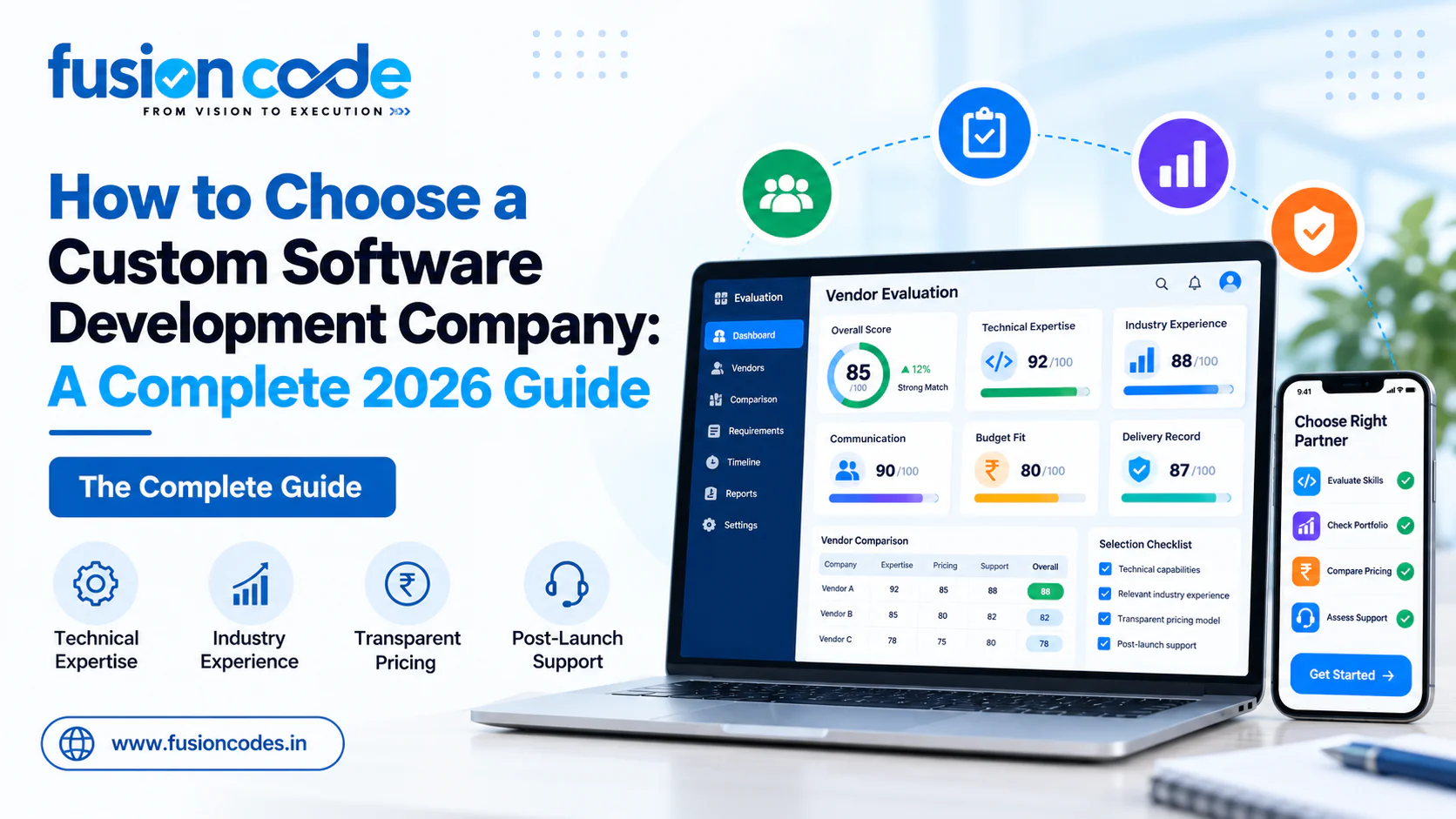
If you’ve never hired a software company before, start here. At Fusion Code, we’ll go through how to choose a custom software development company the way we’d do it if we were in your shoes. There’s a set of questions to take to your first call, too, and a checklist near the end that’s worth printing.
Short version: Honestly, most of it comes down to homework. Write down what you need first. Then find a firm that’s done work in your industry, try out a couple of apps they’ve built, and have a quick chat with their past clients. Ask how they test. And don’t sign until the contract says the code is yours and they’ll stick around after launch.
What Is Custom Software Development?
Put simply, it’s software someone builds just for your business. You don’t change how you work to suit the tool; the tool gets made to suit how you work. Think of a kurta your tailor stitches for you versus one you pick up at the mall.
Custom Software vs Off-the-Shelf Software
Off-the-shelf tools are the ready-made ones, like Zoho, Tally, or Shopify. You sign up in the morning and you’re using them by lunch. If your needs are fairly standard, honestly, they’re often the smarter buy. Custom software is slower to get going, but it works the way you want it to.
| Aspect | Custom software | Off-the-shelf software |
|---|---|---|
| Cost | More upfront, cheaper over the years | Cheap to start, but monthly fees keep coming |
| Fit | Built around your process | Built for the average business |
| Growth | Changes as you grow | You wait for the vendor to add features |
| Ownership | It’s yours | You’re renting it |
| Launch time | A few weeks to several months | Today |
When Does a Business Need Custom Software?
There’s usually a moment when people realise it. Maybe your team is copying data between three apps every evening. Maybe you’re paying for a tool and using a quarter of it, while the one feature you need isn’t there.
You might also be at that point if the way you work is the very thing customers come back for, and no app out there handles it. Or you’re adding staff every few months and the old system just isn’t coping. A few businesses even want to turn their software into a product and sell it to others.
New to all this? Our What Is Custom Software Development? guide covers the basics.
Why Choosing the Right Development Partner Matters
Pick the right company and you’ll hardly think about them. Updates come in, bugs get sorted, and the app keeps up as you grow.
Pick the wrong one and it touches everything. Your launch slips from March to November. Your customer data may not be properly protected. Even a small feature, a couple of years later, turns into a headache.
You hear a few versions of the same story. Sometimes the code is such a mess that the next agency wants to throw it out and start again, so you pay twice. Sometimes only the original team understands what they built, which leaves you stuck with them even when they’re slow or overcharging. And sometimes the money simply runs out before the app ever works.
Compared with any of that, an extra week or two spent choosing carefully costs you very little.
Step-by-Step: How to Choose a Custom Software Development Company
You don’t need to finish all ten in a day. Work through them roughly in order, though, and the weaker companies tend to drop off on their own.
Step 1 – Define Your Project Requirements and Goals
Before calling anyone, sit down for an hour and put your thoughts on paper. What’s annoying you about the current setup? Which features can’t you launch without, and which could wait for version two? What’s the budget, roughly, and when do you want it live?
It doesn’t need to look professional. A page or two in a Google Doc is fine. The real benefit shows up later: when quotes start coming in, everyone’s pricing the same thing, so you can compare them properly. And when a salesperson tries to add extras, you’ve got your list to fall back on.
Step 2 – Check Industry and Domain Experience
If you run a school, you want people who already know what a fee module and an attendance register look like. If you’re in fintech, they should know about KYC without you explaining it. Same goes for ERP, MLM, ecommerce, whatever your field is.
So ask them directly whether they’ve built something in your space. If they say yes, follow up with: what went wrong on that one? Anyone who’s done real projects will have a story. Someone who says “nothing, it went perfectly” probably hasn’t.
Step 3 – Review Portfolio and Case Studies
Any agency can put together a nice slide of screenshots. Ask for a live link or a demo login instead, and spend ten minutes clicking around. Does it load quickly? Does it make sense?
Then look for a project that’s close to yours, and for proof it actually helped the client. Something like “orders went from 2 days to 4 hours” tells you far more than “the client loved it.”
Step 4 – Verify Client Reviews and References
Look the company up on Clutch, GoodFirms and Google. One glowing review doesn’t mean much, and neither does one angry one. Look for the things that come up again and again.
Then ask them for two or three past clients and actually phone them. Ten minutes each is enough. Was the project delivered on time? Did the final bill look like the quote? Would they work with this company again?
Step 5 – Evaluate Technical Expertise and Tech Stack
People throw the term “tech stack” around a lot. All it means is the languages and tools a team uses. You don’t have to understand it.
What matters is whether they’ve used the things your project needs. That could be an Android and iPhone app, AWS hosting, or a link to Razorpay, Tally or your CRM. Know someone who codes? Bring them along to this meeting. They’ll ask questions you wouldn’t think of.
Step 6 – Understand Their Development Process
Ask them how a typical project runs, from day one to launch.
Most good teams now follow an Agile way of working, building in short bursts of one or two weeks called sprints. At the end of each one, they show you what’s ready and you tell them what to fix. That means problems come up in week two instead of month five. Some companies still prefer “waterfall,” where they plan the whole thing first and then build it all in one go. For a small project with a fixed plan, that works fine too.
While you’re at it, ask how they test. A fuzzy answer here is worth writing down.
Step 7 – Assess Communication and Project Management
Honestly, a lot of software projects don’t fail because of bad code. They fail because the two sides stop talking.
Before you sign, agree on who your go-to person is and how often you’ll hear from them (weekly is a good minimum). Settle on how you’ll talk, too. A WhatsApp group works for most small businesses; bigger teams might prefer Slack or a fixed Monday call. If the company is in another country, check you’ll both be online at the same time for at least part of the day.
One small tip: notice how fast they get back to you now, before you’ve signed anything. That’s usually as quick as it gets.
Step 8 – Compare Pricing and Engagement Models
Most firms charge in one of three ways.
| Model | How it works | Suits | Watch out for |
|---|---|---|---|
| Fixed price | One agreed price for the full project | Small, clearly defined projects | Every change becomes an extra bill |
| Time and material | You pay for the hours actually worked | Projects likely to change along the way | Costs can creep up without a cap |
| Dedicated team | You hire a team on a monthly basis | Long-running or ongoing work | Higher monthly spend |
Try not to let price decide this alone. The lowest quote has a habit of becoming the most expensive project.
Step 9 – Check Security, Compliance, and IP Ownership
Most people rush through this bit. It’s also the bit that causes the biggest fights later.
Before you share the full idea, ask for an NDA. Most firms will sign one without any fuss. Next, go through the contract slowly and find the clause about source code. It should clearly say the code belongs to you after the final payment, and if that line’s missing, ask them to put it in. It’s also fair to ask where user data and passwords will be stored, and who on their side can see them. Building something that deals with payments, health info or customer details? Check they know their way around India’s DPDP Act, and GDPR too if any of your users are in Europe.
Step 10 – Confirm Post-Launch Support and Maintenance
A lot of people think the job’s over once the app goes live. It isn’t. Small bugs pop up in the first few weeks, Android and iPhone updates can break things, and your customers will start asking for features you hadn’t planned.
Before you sign, find out how long the free bug-fixing period lasts. Ask what happens if the app crashes at 11 at night: who picks up, and how fast? Check whether there’s a monthly maintenance plan and what it costs. If you’re hoping to grow, ask whether they can handle it when your users go from a thousand to fifty thousand. Whatever they tell you, make sure it ends up in the contract and not just in a WhatsApp message.
Questions to Ask Before Hiring a Software Development Company
We’d suggest keeping these open on your screen during the first couple of calls. Any decent company will answer them happily. If someone starts dodging or changes the topic, that tells you something too.
- Have you built anything like this? Can I try it?
- Who’ll actually be working on my project? (The developers, not the sales team.)
- Will the source code belong to me once it’s finished?
- What if I need to change something halfway?
- How will I see progress each week?
- How do you test things before they go live?
- Who do I contact with questions, and how long do replies usually take?
- How do you keep my idea and my data safe?
- What happens if you miss a deadline? Is there a penalty?
- Can I speak to a few of your past clients?
- What kind of support do I get after launch, and how long does it last?
- Is there anything not included in this quote?
Most people forget to ask the last one. It’s often where the surprise costs are hiding.
Red Flags to Avoid When Choosing a Software Vendor
One of these on its own might have an explanation. If you notice two or three, it’s probably time to look elsewhere.
- A quote far lower than everyone else’s. That money is being saved somewhere, usually on testing, experience, or time. You’ll end up covering it later.
- No proper contract or written scope. Without it, any disagreement becomes your memory against theirs.
- They won’t give you references. Companies with happy clients tend to offer them before you even ask.
- No clear testing process. If they can’t explain how they catch bugs, your customers will catch them instead.
- Fuzzy answers on code ownership. “We’ll figure that out later” isn’t good enough. If you’re paying for the code, it should be yours.
- Saying yes to everything. Every feature, a tiny budget, and a quick launch? Nobody can honestly promise all three.
How Much Does Custom Software Development Cost in India?
It’s the first thing almost everyone asks, and the honest answer is that it depends on what you’re building. Still, these rough ranges should give you a sense of where your project might land.
| Project size | Example | Rough cost (INR) | Rough time |
|---|---|---|---|
| Small | Simple booking app, basic admin panel | ₹3 lakh – ₹10 lakh | 1–3 months |
| Mid-size | Ecommerce store, school ERP, CRM with mobile app | ₹10 lakh – ₹40 lakh | 3–6 months |
| Enterprise | Large ERP, fintech platform, multi-country system | ₹40 lakh and above | 6–12+ months |
These are rough market ranges. Your real quote can be higher or lower. [Add your own pricing here if you want to share it.]
What Changes the Cost?
- Number of features. More screens and functions mean more hours.
- Integrations. Linking to payment gateways, SMS, ERPs, or third-party APIs adds work.
- Platforms. Web only costs less than web plus Android plus iPhone.
- Design. A custom look costs more than a clean, simple layout.
- Team size and seniority. A senior developer charges more per hour, but usually gets things done quicker, so it often evens out.
Why Do So Many Businesses Outsource to India?
Cost is the obvious one. A good developer here charges far less than someone doing the same work in the US or UK. But price isn’t the whole story. India turns out a huge number of engineering graduates every year, so finding people with the right skills is easier. And since most teams are comfortable working in English, very little gets lost in the back-and-forth.
Best Custom Software Development Company in India: What to Look For
When people search for the best custom software development provider in India, they’re usually hoping for one name. Truthfully, the right company depends on what you’re building and how you like to work. Still, the good ones tend to have a few things in common.
They’ve been around for a while and have plenty of finished work to show you. Their apps are live and you can try them, not just mockups in a PDF. Their reviews sound like real people wrote them, with actual details rather than “great service!” They’re happy to put scope, price and code ownership on paper. And they don’t disappear the week after launch.
About Fusion Code
Fusion Code is a custom software development company based in Lucknow, Uttar Pradesh. We have been building software for [X] years. In that time, we have delivered [X]+ projects for clients in [X] countries.
We work across fintech, ERP, education, MLM, and ecommerce. [Add certifications here, e.g. ISO 9001, ISO 27001.]
Case study: [Client name or type of business]
- The problem: [One line on what was not working.]
- What we built: [One line on the solution.]
- The result: [One line with a number, e.g. “cut manual work by 60% in three months.”]
Tip: Fill in real numbers and names here. AI search tools quote clear facts much more often than sales lines.
Custom Software Development Company Selection Checklist
Use this table to score each firm on your shortlist.
| Step | What to check | Done? |
|---|---|---|
| 1. Requirements | Problem, features, budget, and deadline are written down | ☐ |
| 2. Industry experience | They have worked in your field before | ☐ |
| 3. Portfolio | You have seen live work like yours | ☐ |
| 4. Reviews and references | Good reviews online, and you spoke to past clients | ☐ |
| 5. Tech skills | They know the tools your project needs | ☐ |
| 6. Process | They build in short rounds and test well | ☐ |
| 7. Communication | One contact, weekly updates, shared work hours | ☐ |
| 8. Pricing model | The model fits your project, and costs are clear | ☐ |
| 9. Security and ownership | NDA signed, you own the code, data is safe | ☐ |
| 10. Support | Bug-fix period and support plan are in the contract | ☐ |
Frequently Asked Questions
How do I choose a custom software development company?
Start by writing down what you need, your budget, and your deadline. Then shortlist firms that know your industry. Check their past work and call their old clients. Make sure they test well and talk often. Before signing, confirm you will own the code and get support after launch.
How long does custom software development take?
It depends on size. A small app often takes one to three months. A mid-size system, like an online store or school ERP, takes three to six months. Large enterprise software can take six months to a year or more. Clear plans and quick feedback from you help speed things up.
How much does custom software cost in India?
A small project often costs ₹3 lakh to ₹10 lakh. Mid-size projects usually fall between ₹10 lakh and ₹40 lakh. Large enterprise systems can cost ₹40 lakh or more. The final price depends on features, design, platforms, integrations, and the size of the team working on it.
Is it better to hire a freelancer or a software company?
A freelancer works well for small, simple tasks on a tight budget. A software company is safer for bigger projects. It gives you a full team of designers, developers, and testers. It also offers backup if someone leaves, a formal contract, and support after launch.
What is the difference between custom and off-the-shelf software?
Off-the-shelf software is ready-made for many users. It is quick to start and cheap at first, but you rent it and cannot change much. Custom software is built only for you. It costs more to start, but you own it, and it fits exactly how your business works.
Who owns the source code in custom software development?
It depends on your contract. In most fair deals, you own the source code once you have paid in full. Never assume this. Make sure the contract says it clearly, in plain words. Also ask the firm to hand over the full code and access details at the end.
What questions should I ask a software development company?
Ask if they have built something like your project. Ask who will own the code, how they handle changes, and how they test. Ask how often you will get updates and who your main contact is. Finally, ask for client references and what support they offer after launch.
Final Thoughts
Picking a software partner is a big call, but it does not have to be hard. Know what you need before you start. Check each firm’s past work, talk to their clients, and see how they build and test. Then get price, code ownership, and support in writing before you sign.
Do these few things, and you will avoid most of the problems that sink software projects.
Have a project in mind? Book a free consultation with Fusion Code. Tell us what you want to build, and we will send you a clear plan and project estimate.
Book a Free Consultation · Get a Project Estimate