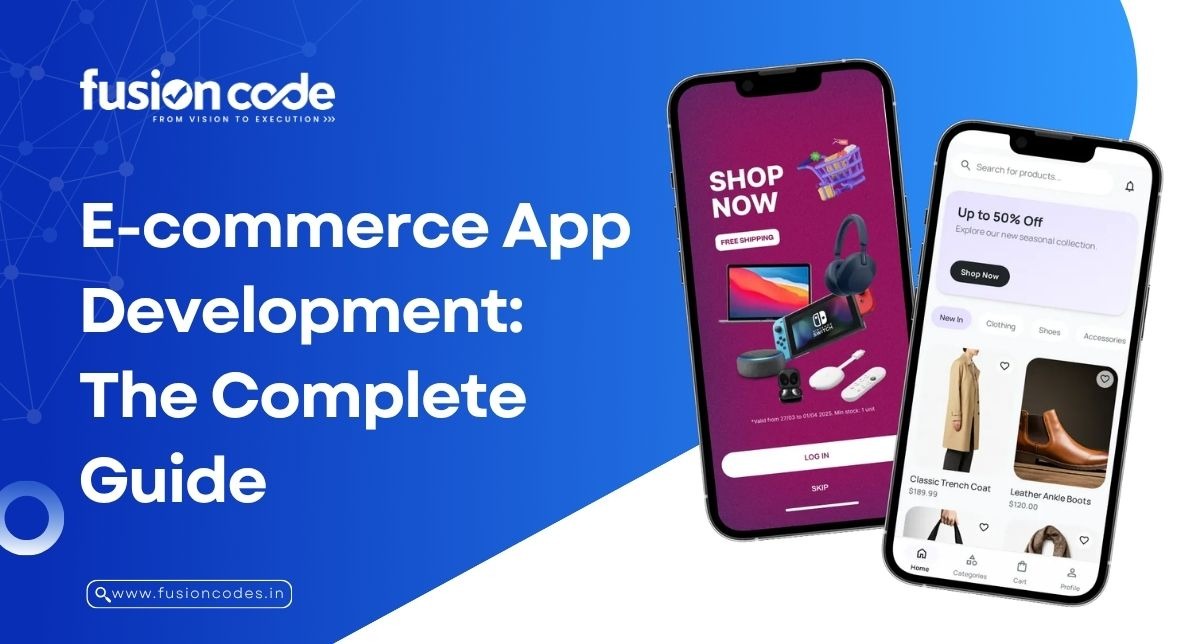
A slow product page costs sales the second it happens. No second chance, really; the customer’s already tapped over to a competitor’s app by the time your page finishes loading.
E-commerce App Development exists to close that exact gap, building something fast and reliable enough that people actually finish the purchase they started instead of bailing halfway through.
Fusion Codes builds these apps end to end, planning through post-launch support, so here’s what actually goes into building one, what it tends to cost, and where most businesses get the platform decision wrong before development even starts.
What Is E-commerce App Development?
Simple version. E-commerce app development means building a mobile app that lets customers browse products, manage a cart, pay, and track orders from their phone instead of a browser tab. Covers everything, from visual design to the backend handling inventory and payments quietly behind the scenes.
E-commerce Website and App Development: Knowing the Difference
A website needs no install and reaches anyone with a browser. An app demands a download, sure, but it pays that back with push notifications, faster repeat visits, and browsing that still works offline. That’s usually why apps convert better for customers already shopping with a brand regularly. Most serious e-commerce businesses end up running both eventually, not picking one over the other.
Choosing an E-commerce App Development Company
The platform decision matters. Honestly though, the team building it matters more. A great tech stack choice still falls apart in the hands of a team that’s never actually shipped a real checkout flow before.
How to Choose an E-commerce App Development Company
- Ask to see actual e-commerce apps they’ve built, not some generic portfolio slide
- Check whether they handle payment gateway integration and PCI-DSS compliance themselves or just outsource it
- Confirm post-launch support is included, not billed separately the moment something breaks
- Ask which framework they’d recommend for your case specifically and why, instead of whatever they happen to know best
E-commerce App Developers: What to Look For in a Team
Raw coding skill isn’t really the whole picture with good e-commerce app developers. They need to talk through inventory sync issues, payment failure handling, and why a catalogue with 50,000 SKUs behaves nothing like one with 200 SKUs; that gap alone changes architecture decisions right from day one.
Native vs Hybrid: Android, iOS, and Cross-Platform
One decision, and it shapes budget and timeline more than almost anything else in the whole project, honestly.
Which Platform Is Best, Native or Hybrid?
Go native, and you get the smoothest performance and full access to platform-specific features, with Android e-commerce app development and iOS e-commerce app development done separately. Costs you two entirely separate codebases to maintain, though.
Cross-platform app development builds once and ships to both instead, trading a bit of performance for noticeably lower cost and a faster timeline. Which is why most e-commerce apps these days go that route, unless performance genuinely has to be perfect.
Flutter vs React Native for E-commerce Apps
| Factor | Flutter | React Native |
| Performance | Near-native, compiled | Very good, bridge-based |
| UI consistency | Identical across platforms | Slight platform variation |
| Developer availability | Growing steadily | Larger existing talent pool |
| Best fit | Apps prioritising pixel-perfect design | Apps needing rapid market entry |
Both handle e-commerce workloads just fine. Flutter tends to edge ahead on visual consistency between Android and iOS. React Native, meanwhile, benefits from a bigger, more mature ecosystem of plugins already built specifically for commerce.
E-commerce Mobile App Development Process
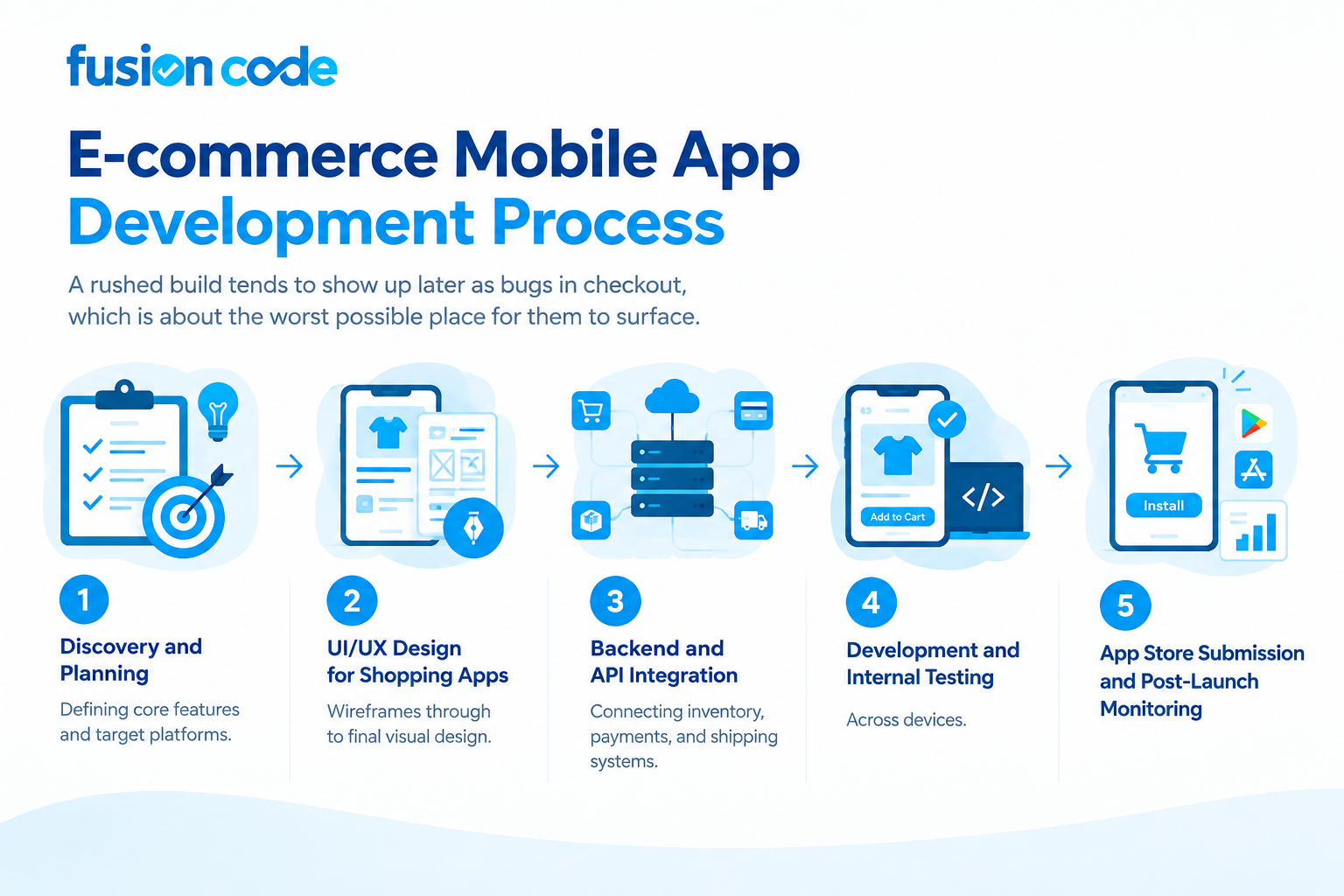
A rushed build tends to show up later as bugs in checkout, which is about the worst possible place for them to surface.
- Discovery and planning, defining core features and target platforms
- UI/UX design for shopping apps, wireframes through to final visual design
- Backend and API integration, connecting inventory, payments, and shipping systems
- Development and internal testing across devices
- App store submission and post-launch monitoring
MVP (Minimum Viable Product) Development
Loading up an app with every feature before anyone’s confirmed real demand exists is a mistake businesses make constantly and an expensive one. MVP development flips that. Ship the core stuff – browsing, cart, and checkout – first. Gather actual feedback. Only then spend on wishlist features, loyalty programmes, or AR try-on tools that might not even matter to your customers anyway.
Progressive Web App (PWA) as an Alternative
Somewhere between a website and a native app sits a progressive web app. Installable right on a home screen, push notifications work fine, no app store listing is needed at all. Decent starting point, actually, for businesses just testing app-like functionality before committing to a full native or cross-platform build.
Core Features Every Shopping App Needs
Skipping the basics to chase flashy features tends to backfire fast with actual customers.
| Feature | Why It Matters |
| Shopping cart functionality | Core to completing any purchase |
| Product catalogue management | Keeps inventory and listings accurate |
| Push notifications | Drives repeat visits and cart recovery |
| Order tracking system | Reduces “where’s my order” support tickets |
| Wishlist and personalisation | Increases return visits and repeat purchases |
| Customer reviews and ratings | Builds trust before a purchase decision |
| Payment gateway integration | Enables actual checkout completion |
Payment Gateway Integration: Stripe, PayPal, Razorpay
Payment gateway integration should really support more than one provider where possible: Stripe and PayPal for international reach, Razorpay for solid performance in the Indian market specifically. Stick to just one gateway, and you’ll quietly lose sales the moment a customer’s preferred payment method isn’t sitting there at checkout.
App Security and Data Encryption: GDPR/PCI-DSS Compliance
Handling payment data means PCI-DSS compliance isn’t really optional, and GDPR kicks in the moment European customers are in scope, no matter where the business itself is based.
App security and data encryption need to be built in from the architecture stage, not patched on later once a security review flags the gap. For the current official standard on payment data handling, the PCI Security Standards Council publishes the requirements directly.
Advanced Features: AI, AR/VR, and Chatbot Integration
Get the fundamentals actually working reliably first. That’s when advanced features start paying off instead of just becoming a distraction from what matters.
Browsing history and past purchases – that’s what an AI-powered recommendation engine works off to suggest products, and done right, it genuinely lifts average order value.
AR/VR try-before-you-buy features do something similar for a different problem, letting customers preview furniture in a room or see how something actually looks before they commit to buying it. Fashion and home goods especially benefit here.
Chatbot Integration for E-commerce Apps
Chatbot integration handles order status questions, product queries, and basic support instantly, whether that’s inside the app itself or through a channel customers already use like WhatsApp. Businesses running a WhatsApp-based chatbot alongside their app, similar to what Fusion Codes builds through its WhatsApp CRM solutions, end up with a consistent support experience no matter which way the customer reaches out.
Read Also: Google Ads Management Company: Complete Guide by Fusion Codes
Custom E-commerce App Development vs Platform-Based Builds
Not every business actually needs a fully custom build, and pretending otherwise just wastes budget for no real reason.
Shopify, Magento, WooCommerce: When Off-the-Shelf Makes Sense
Shopify, Magento, and WooCommerce all offer app extensions or plugins that get a business selling fast, no custom development timeline needed. Works well for smaller catalogues and simpler business models. Custom e-commerce app development starts earning its cost once the business needs specific workflows, unusual inventory logic, or scale; these platforms just weren’t built to handle gracefully.
Headless Commerce Architecture Explained
Headless commerce architecture splits the frontend shopping experience away from the backend commerce engine, letting a business build a fully custom app interface while still leaning on a proven backend for inventory, orders, and payments. A decent middle ground for businesses wanting custom design without rebuilding core commerce logic from scratch.
Backend, Hosting, and Search Infrastructure
The parts customers never see directly still decide whether the app actually holds up once real traffic hits it.
Hosting on AWS, Google Cloud, or Firebase gives scalable infrastructure that grows with order volume instead of buckling the moment a sale event drives traffic up. Search matters more than most businesses expect too. Elasticsearch or Algolia power fast, typo-tolerant product search, which directly decides whether customers find what they want or just give up and leave.
Multi-Vendor Marketplace Apps: Added Complexity
A multi-vendor marketplace app adds real complexity on top of a standard single-seller store: separate vendor dashboards, commission tracking, multi-party payment splits, and moderation tools – all of it. Needs planning from day one, not retrofitted later, since the underlying data model looks nothing like a single-store app once vendors enter the picture.
E-commerce App Development Cost
Pricing swings heavily based on feature scope, platform choice, and whether it’s custom or platform-based to start with.
| App Complexity | Approximate Cost Range | Typical Timeline |
| Basic MVP, single platform | Lower end of the budget range | 6-10 weeks |
| Mid-range app, cross-platform | Moderate investment | 3-5 months |
| Full custom, multi-vendor or advanced features | Significant investment | 6+ months |
Exact e-commerce app development cost varies quite a bit by region and by team, so treat this table as a general guide rather than an actual quote; real numbers depend on your specific feature list and whichever company’s rate structure you’re working with.
The timeline tends to follow the same pattern: a basic app with core features can launch in under two months, while a fully custom build with multi-vendor support, AI recommendations, and AR features realistically takes six months or more, start to finish.
No-Code Tools vs. a Development Team
Simple shopfront, not much customisation needed; no-code tools do the job fine. But the second a business wants custom checkout logic, some unusual inventory workflow, or integrations a no-code platform just doesn’t support out of the box, that’s the moment a real development team stops being optional.
Starting points are the same regardless, though. Pin down the actual problem the app solves for customers. Pick a platform approach that fits the budget and complexity. Build an MVP. Layer in the fancier stuff only once real usage data starts rolling in.
App Store Optimisation (ASO) and Monetisation
Building the app is genuinely only half the job. Getting it found and getting it to make money – that’s the other half.
App store optimisation, ASO, comes down to the title, the description, screenshots, and keywords – tuning all of it so the app actually shows up somewhere useful in App Store and Google Play search results.
Not surprising really, given most people still find apps through in-store search rather than some ad campaign running elsewhere. Want the official word on what gets an app approved and discoverable in the first place? Apple’s App Store Review Guidelines lay it out straight from the source.
Frequently Asked Questions
What is e-commerce app development?
It’s the process of building a mobile app that lets customers browse, purchase, and track orders from a business, covering everything from UI design to backend payment and inventory systems.
How much does it cost to build an e-commerce app?
Costs run from a modest budget for a basic MVP on one platform up to a significant investment for a fully custom, multi-vendor app with advanced features, depending heavily on scope.
How long does it take to develop an e-commerce app?
A basic app can launch in six to ten weeks. A fully custom build with advanced features typically takes six months or more from discovery through launch.
Which platform is best for e-commerce app development, native or hybrid?
Native suits apps where performance absolutely has to be flawless, but cross-platform frameworks like Flutter and React Native handle most e-commerce needs well, at noticeably lower cost and faster timelines.
What features should an e-commerce app have?
At minimum, shopping cart functionality, product catalogue management, payment gateway integration, push notifications, order tracking, and customer reviews.
How do I create my own shopping app?
Define the core customer problem first, choose a platform approach based on budget and complexity, then build an MVP with a development team before adding advanced features later.
What is the difference between an e-commerce website and an app?
A website needs no installation and reaches anyone with a browser. An app requires downloading but generally offers push notifications and faster performance for repeat customers.
Which technology stack is best for e-commerce apps?
Depends on the project, honestly. Flutter and React Native both handle e-commerce workloads well for cross-platform builds, while Swift and Kotlin suit projects needing fully native performance on iOS or Android specifically.
Do I need a developer, or can I use no-code tools?
No-code tools work for very simple shopfronts, but custom checkout logic, unusual workflows, or complex integrations generally need an actual development team behind them.
How to choose an e-commerce app development company?
Look at their actual e-commerce portfolio, confirm they handle payment security directly, check post-launch support is included, and ask which tech stack they’d recommend for your case specifically and why.
Is Flutter or React Native better for e-commerce apps?
Flutter tends to offer more visual consistency across platforms. React Native benefits from a larger existing developer pool and plugin ecosystem. Both are solid choices depending on team familiarity and project priorities.
How to monetise an e-commerce app?
Direct product sales remain the main model, supplemented by featured vendor listings on marketplace apps, premium subscription tiers, or affiliate placements for complementary products.
Ready to build an e-commerce app that actually converts browsers into buyers? Reach out to Fusion Codes for an e-commerce app development plan built around your catalogue, budget, and timeline.
Fusion Codes: E-commerce App Development Services
Fusion Codes builds e-commerce platforms end-to-end: custom web and mobile development, UI/UX design, backend integration, post-launch support, and the whole stack.
One example from the portfolio, Wow Fashion, a women’s ethnic wear e-commerce store built to load fast and actually make browsing enjoyable rather than just functional, reflects the same approach carried across mobile app projects too.
The company operates under ISO 9001, ISO 27001, ISO 20000, and ISO 22301 certifications, covering quality management, information security, IT service management, and business continuity.
Matters a lot for e-commerce projects specifically, given how much sensitive payment and customer data flows through these systems daily.