Almost every founder hits the same wall. You want to offer payments, maybe even become a processor yourself. But building that from scratch takes a year, sometimes two.
Most businesses don’t have that kind of runway. So they take a different route: a white label payment solution.
At Fusion Codes, we hear versions of this same conversation constantly. Some teams want full ownership of the tech. Most just want something reliable that looks like theirs, without a year of engineering work.
This guide covers what a white label payment solution is, how it works, what it costs, and how to decide if it’s right for you.
What Is a White Label Payment Solution?
The Basic Idea
It’s a payment platform someone else already built. You rebrand it and run it as your own.
The provider, like Fusion Codes, handles the messy parts:
- Transaction processing
- Compliance and security
- Fraud checks
- Reporting and reconciliation
You focus on what customers actually see: your logo, your domain, your checkout flow, and your pricing.
Why It Works
Instead of spending months on a payment processing platform from scratch, a business simply licenses one. The servers, banking relationships, fraud detection, and payment reconciliation software are already running.
That’s the real appeal of a white label fintech solution. Someone already did the unglamorous work.
How Does a White Label Payment Gateway Work?
A white label payment gateway sits between a checkout page and the banking rails that move money.
The Transaction Flow
Here’s roughly what happens on each transaction:
- A customer pays online or in an app, or taps a card at a contactless payment solution terminal
- The gateway encrypts the data and routes it through payment gateway integration APIs
- A card network, bank, or alternative payment rail authorizes it
- Funds settle, and the platform provider takes its cut
- Reporting and reconciliation happen automatically inside a dashboard
Compliance Still Applies
Because Fusion Codes owns the payment orchestration platform underneath, your business runs a working, compliant system from day one.
It just carries your name instead of ours. Any platform touching card data still has to meet the PCI Security Standards Council requirements, licensed or not.
Types of White Label Payment Products
“White label payment solution” covers more ground than most people expect.
Common Product Types
- White label payment gateway software: for offering merchant payment processing to other merchants
- White label digital wallet: a branded app for balances, transfers, and payments, often with loyalty built in
- Reseller payment gateway: reselling someone else’s gateway capacity under your brand, faster but less customizable
- White label neobank platform: a full banking experience (accounts, cards, transfers) on banking-as-a-service infrastructure
Speed vs Control
Reseller setups can go live in a couple of weeks. A fully customised embedded payment solution takes longer but gives you more control over pricing, experience, and data.
Benefits of a White Label Payment Solution for Business
Speed and Cost
An 18 to 24-month build shrinks to roughly 8 to 12 weeks.
Building compliance, certifications, and banking relationships from nothing is expensive. White label spreads that cost across every client the provider serves.
Reach and Reliability
A solid multi-currency payment gateway lets you settle payments across regions without new banking relationships each time. Global digital payment volume keeps climbing, a trend Statista’s digital payments market data tracks closely.
Manual reconciliation drains teams fast. Most modern platforms build real-time payment reconciliation software directly into the dashboard.
Scale and Brand Control
As transaction volume grows, the infrastructure grows with it. No rebuilding required.
Your brand stays visible the entire time, even while a third party runs things behind the scenes.
White Label Payment Solution vs Custom Payment Gateway
There’s no single right answer here. It depends on your resources, your timeline, and your five-year plan.
| Factor | White Label Solution | Custom-Built Gateway |
| Time to Launch | Weeks to a few months | 12 to 24+ months |
| Upfront Cost | Lower | Significantly higher |
| Compliance Burden | Handled by provider | Owned entirely by you |
| Customization Depth | Moderate to high | Unlimited |
| Long-Term Ownership | Licensed technology | Fully owned IP |
| Best For | Startups, resellers, and banks entering fintech | Large enterprises with big budgets |
Custom builds suit a specific kind of company: strong in-house engineering, unique needs, and years of runway. Most others do better going white-label.
White Label Payment Solution Cost
What You’re Paying For
Pricing shifts depending on the provider and customisation level. Most solutions combine:
- A one-time setup or licensing fee
- Ongoing monthly platform fees
- Per-transaction processing fees (a small percentage plus a flat amount)
- Optional add-ons, like a white label wallet with loyalty program
Why It’s Usually Cheaper
A custom build can cost hundreds of thousands before a single transaction happens. White label solutions turn cash flow positive much sooner.
You’re mostly paying for usage, not years of development.
White Label Payment Solutions for Startups and E-Commerce
For Startups
This model clears out one of the biggest early obstacles: regulatory and banking complexity.
Instead of filing for licenses yourself, you plug into infrastructure that’s already compliant.
For E-Commerce
White label gateways hand you control over the whole checkout experience.
- Fewer abandoned carts
- Support for local payment methods
- A fully branded path from browsing to checkout confirmation
How to Start a Payment Service Provider Business
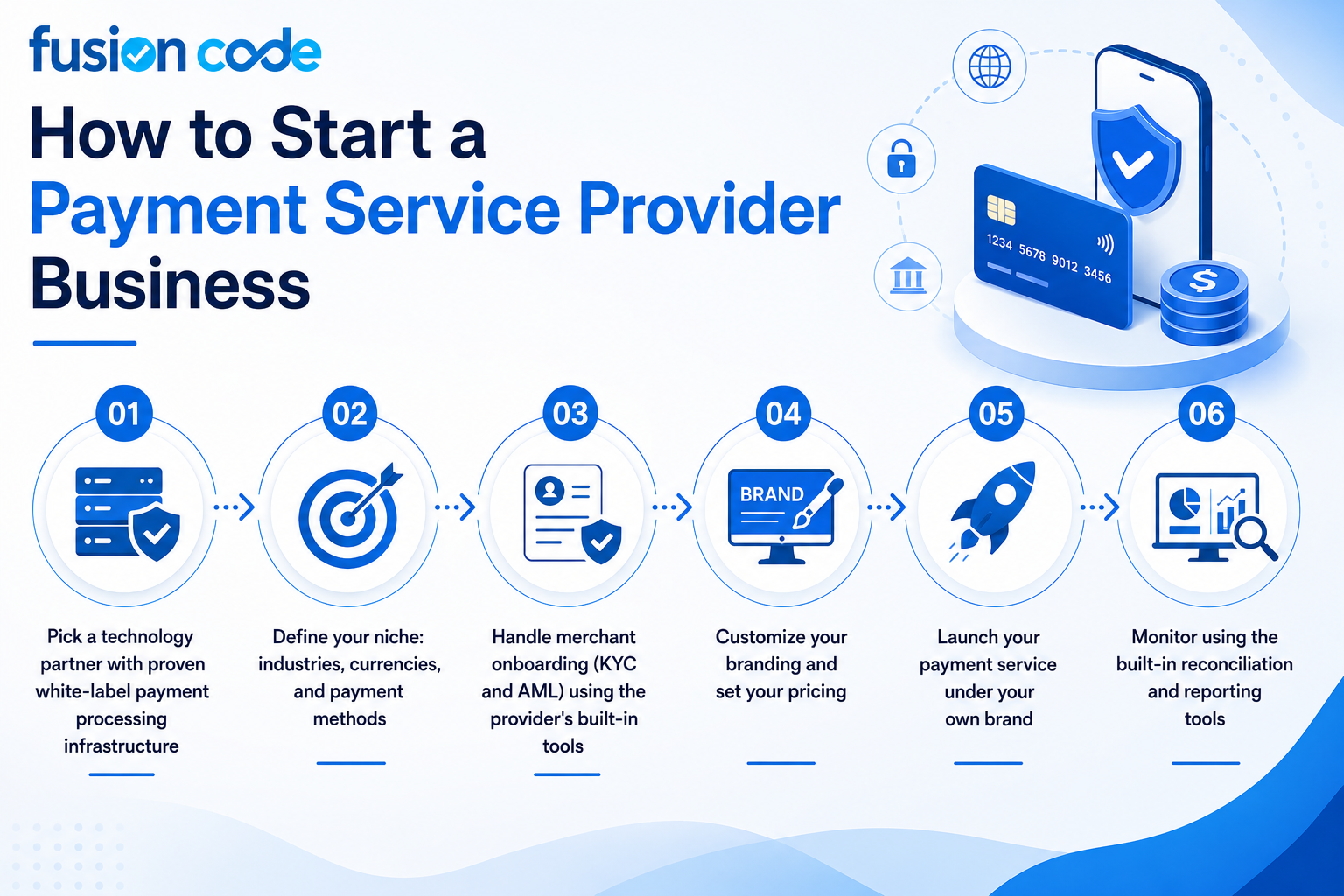
White label is usually the fastest realistic way to become a payment service provider (PSP).
- Pick a technology partner with proven white-label payment processing infrastructure
- Define your niche: industries, currencies, and payment methods
- Handle merchant onboarding (KYC and AML) using the provider’s built-in tools
- Customize your branding and set your pricing
- Launch, then monitor using the built-in reconciliation and reporting tools
Final Words
Nobody thinks about payments until something breaks. That’s why the technology underneath matters so much.
A white-label payment solution isn’t a shortcut on quality. It’s a shortcut on time and cost, freeing you up to focus on the product itself.
If you’re still weighing this decision, it’s worth an actual conversation before locking anything in. Fusion Codes is glad to be that conversation.
Frequently Asked Questions
What is a white label payment solution?
A pre-built payment platform businesses can rebrand and offer as their own without building the technology or compliance layer from scratch.
How does a white label payment gateway work?
It routes payment data through secure APIs to banks and card networks, then returns authorisation and reporting data through a branded dashboard.
White label payment solution vs custom payment gateway: which is better?
White label is faster and cheaper to launch. Custom gateways offer more flexibility but demand far more time and money.
What are the benefits of a white label payment solution for business?
Faster launch, lower costs, built-in compliance, multi-currency support, and full control over your brand experience.
How much does a white label payment solution cost?
Usually a setup fee, a monthly platform fee, and per-transaction processing fees, depending on the provider and volume.
Is a white label payment solution good for startups?
Yes. It removes the earliest hurdles, like licensing and compliance, so a startup can launch in weeks or months instead of years.
How do I start a payment service provider business?
Find a white label infrastructure provider, define your market, sort out compliance, customise your branding, and launch under your own name.